
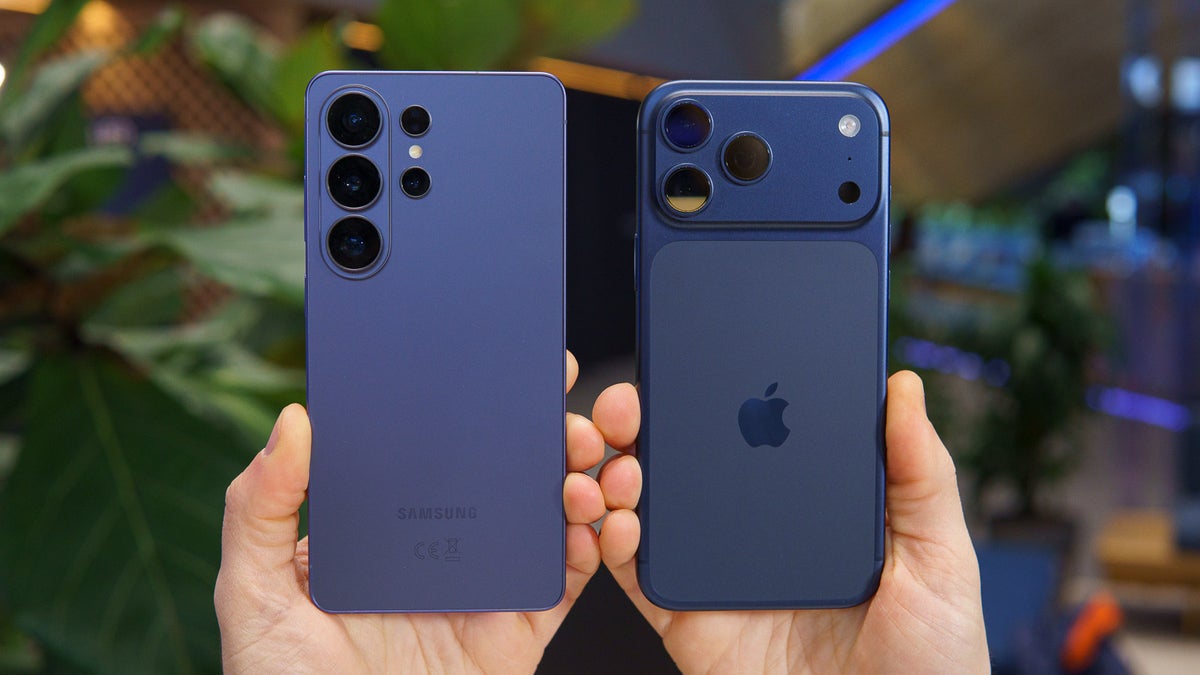
How will it stack up against the best Apple device out there, the iPhone 17 Pro Max? With a bold and provocative new design, top-notch performance, and a new interface, it’s the ultimate iOS-powered phone to get this year.
But anyway, pound for pound, which one’s the better phone?
Samsung Galaxy S26 Ultra vs Apple iPhone 17 Pro Max differences:
| Galaxy S26 Ultra | iPhone 17 Pro Max |
|---|---|
| Design | |
| Visual continuation of the Galaxy S25 Ultra design language | A new design with a large camera plateau at the rear |
| Thinner at 7.9 mm | 8.75 mm thick |
| Display | |
| 6.9-inch QHD+ AMOLED display. 1-120 Hz | 6.9-inch Liquid Retina XDR, 1-120 Hz ProMotion |
| Lower peak brightness (2,600 nits) | 3,000 nits of peak brightness |
| Privacy Display feature | No Privacy Display feature |
| Gorilla Glass Armor | Ceramic Shield 2 |
| Performance | |
| Snapdragon 8 Elite Gen 5, 3nm | Apple A19 Pro, 3nm |
| 12GB RAM, 256GB/512GB versions + (16GB/1TB version) | 12GB RAM, 256GB – 2TB storage versions |
| Wi-Fi 7, Bluetooth 6 | Wi-Fi 7, Bluetooth 5.4 |
| Camera | |
| Quad camera (200MP + 10MP 3X + 50MP 5X + 50MP ultra) | Triple 48MP cameras |
| Battery | |
| Smaller 5,000 mAh battery | A larger 5,088 mAh battery |
| An upgrade to 60W wired charging | Upgraded from 27W to 40W wired charging |
| No magnetic attachment support | MagSafe 2.0 25W wireless charging |
Table of Contents:
Design and Size
Thinner bodies, larger plateaus
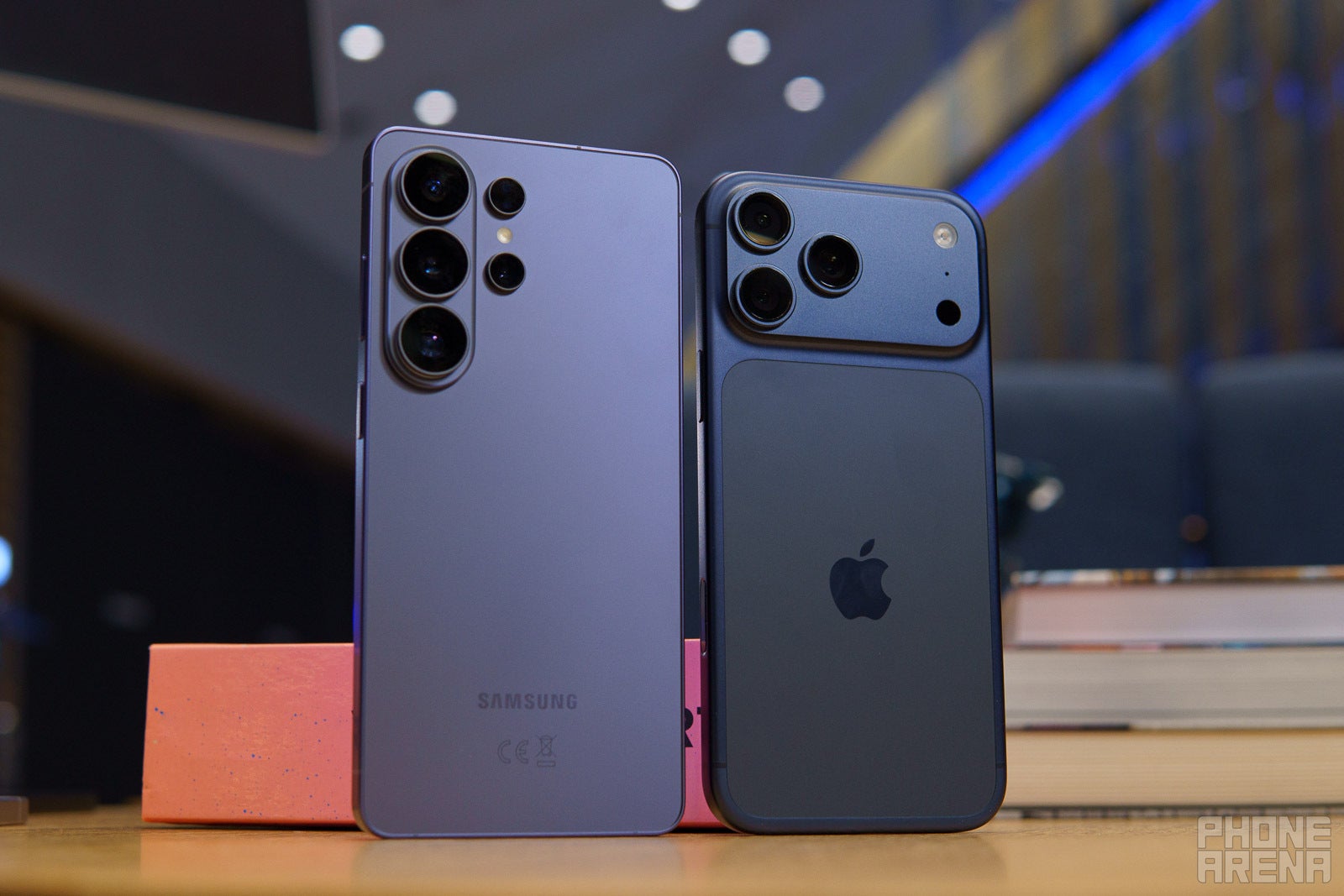
Towering above their rivals | Image by PhoneArena
Meanwhile, the iPhone 17 Pro Max is reiterating the flat design language but now switches the titanium unibody for an aluminum one for cost-reducing and temperature-decreasing reasons. The design is also two-tone, with the rear of the device dominated by a glass cutout that complements the Liquid Glass design language well.
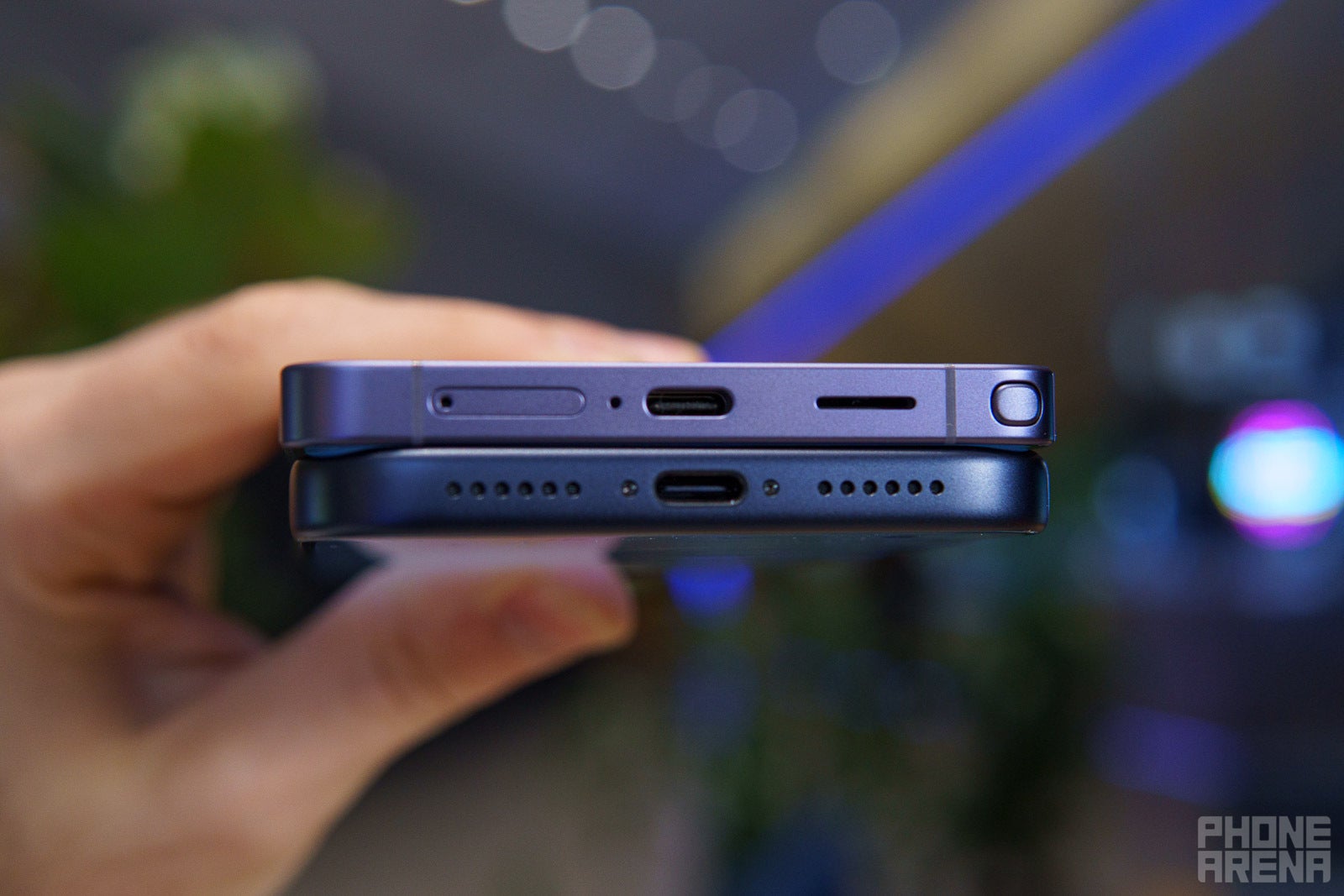
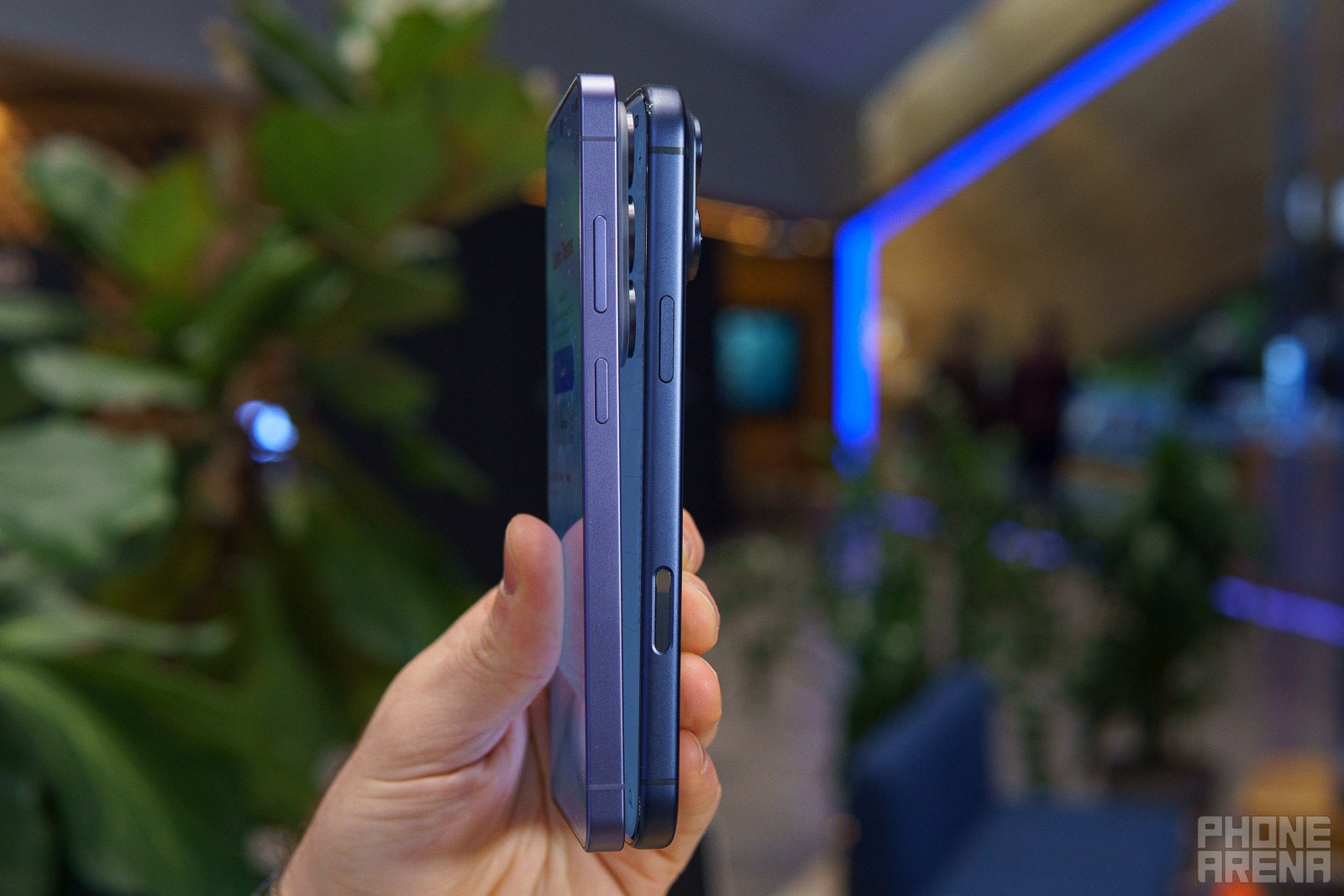
Image by PhoneArena
The iPhone 17 Pro Max now features an incredibly wide and tall camera island at the rear, which has logically been granted the “camera plateau” moniker. It’s certainly something very different from what we saw on previous iPhones, but it isn’t something that took too long to get used to.
Size-wise, the Galaxy S26 Ultra is slightly thinner than the iPhone 17 Pro Max, but also marginally taller and wider. Not that you’d notice that, though. What you’d definitely notice is the weight of it all: the Galaxy S26 Ultra is much lighter than the iPhone 17 Pro Max.
| Galaxy S26 Ultra | iPhone 17 Pro Max |
|---|---|
| Thickness 7.9 mm |
Thickness 8.8 mm (10 mm with camera plateau) |
| Dimensions 163.6 x 78.1 mm |
Dimensions 163.4 x 78 |
| Weight 214 g |
Weight 233 g |
The Galaxy S26 Ultra retains the IP68 water and dust resistance, and so does the iPhone 17 Pro Max.
The iPhone 17 Pro Max is available in Silver, Cosmic Orange, and Deep Blue. The Galaxy S26 Ultra arrive in Black, White, Silver Shadow, Sky Blue, Cobalt Violet, and Pink Gold colors.
Display Differences
The Galaxy S26 Ultra comes with largely the same display as its predecessor, with just a couple of notable upgrades.
Another improvement is the new Privacy display feature, which automatically keeps sensitive data away from prying eyes. You can choose what content is protected and under what conditions; you can also set the intensity of the functionality, which is a software replacement for physical privacy screen protectors.
| Galaxy S26 Ultra | iPhone 17 Pro Max |
|---|---|
| Size 6.9-inch |
Size 6.9-inch |
| Brightness 2,600 nits (peak) |
Brightness 3,000 nits (peak) |
| Privacy display feature, anti-reflective coating | Anti-reflective coating |
| Refresh rate 1-120Hz |
Refresh rate 1-120Hz |
What about the display quality?
The Galaxy S26 Ultra lives up to Samsung’s peak brightness claims, achieving a little over 2,400 nits and also an exceptional minimum brightness of just 0.8 nits.
The iPhone 17 Pro Max relies on Face ID, while the Galaxy S26 Ultra arrives with an ultrasonic fingerprint scanner embedded in the screen.
Performance and Software
Exceptional power on both ends
The Galaxy S26 Ultra comes with the Qualcomm Snapdragon 8 Elite Gen 5 chipset globally, a successor to the Snapdragon 8 Elite. This chipset is the fastest and best-performing chip currently available to Android manufacturers. The phone also comes with 12 GB of RAM in the 256 GB and 512 GB versions, while the 1 TB version comes with 16 GB of RAM.
Meanwhile, the iPhone 17 Pro Max comes with the super-fast Apple A19 Pro chip, a third-generation 3nm chipset, which delivers excellent performance. It’s also the first iPhone to have a vapor chamber inside for improved thermal management.
| Galaxy S26 Ultra | iPhone 17 Pro Max |
|---|---|
| Chip Qualcomm Snapdragon 8 Elite Gen 5 |
Chip Apple A19 Pro |
| Process 3nm |
Process 3nm |
| RAM, Storage 12/256GB 12/512GB 16/1TB |
RAM, Storage 12/256GB 12/512GB 12/1TB 12/2TB |
CPU Performance Benchmarks:
In the 3DMark Extreme stress test, the Galaxy S26 Ultra also serves a surprise: it easily beats the iPhone in peak graphics performance by a pretty significant margin! The sustained graphics performance is slightly better on the iPhone 17 Pro Max, but let’s be honest here: both are neck and neck.
GPU Performance:
First, the software scores a new floating app bar at the bottom, which should improve the readability. Next up, One UI 8.5 now offers even more customization options and lets you personalize the Quick Settings panel even more by reordering and removing existing controls.
If you set a picture of a person or a pet as your lock screen wallpaper, the layout will automatically move around so that neither the clock nor the widgets obscure key parts of the image. There are a few extra customization options for the lock screen clock, too.
Galaxy AI has been upgraded with continuous image generation, which lets you generate several images without stopping and pick from the ones you want afterward.
Call Screening is another new feature that will let Galaxy AI answer calls for you and see who’s calling and for what reason. You will be provided with a transcript and only then decide if you want to answer the call.
Bixby can now understand you better when you talk to the assistant in your words. This lets you use it to find specific settings or features without having to sift through numerous menus. It now has an easy way of accessing your conversation history with Bixby.
The Galaxy S26 now comes with an AI-powered screenshot analyzer, which will automatically sort your screenshots into one of eight categories. You can then find these screenshots by simply searching for said category.
The Weather app has scored a more detailed new widget that will showcase a graph of any upcoming precipitation that is expected. Your daily alarms can also show the current weather as a background when they ring, which is a neat quality-of-life upgrade.
Samsung has also enhanced the battery info menu, making it easier to check the remaining battery life left, the battery usage, as well as your charging status. There are also two power-saving modes now: Standard, which is more temperate, and Maximum, which disables all non-essential features to boost battery life.
Camera
Slight improvements
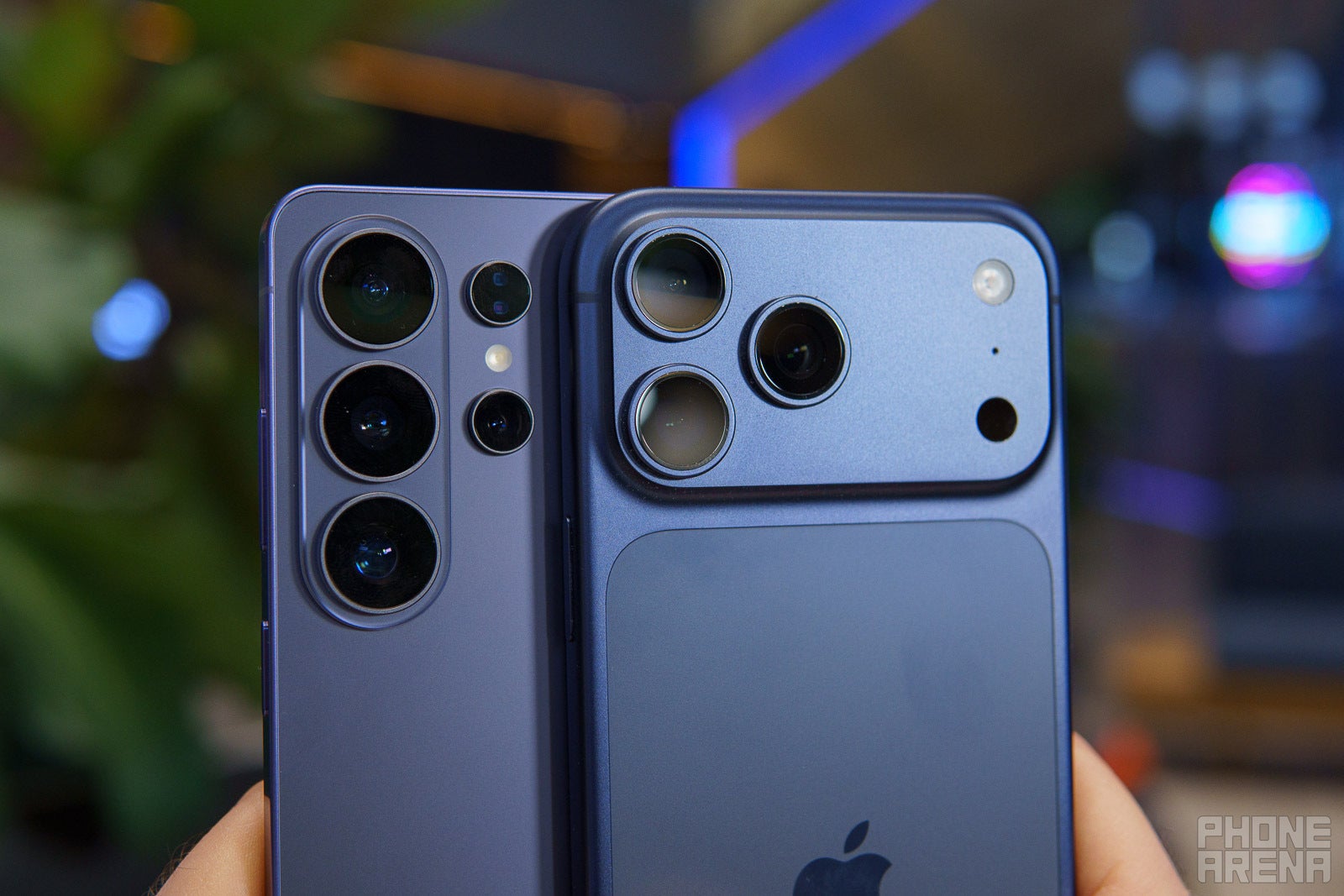
The iPhone 17 Pro Max and Galaxy S26 Ultra cameras will brawl for the top spots. | Image by PhoneArena
The Galaxy S26 Ultra comes with pretty much the same camera system as the Galaxy S25 Ultra. Think of a 200 MP main camera, a 50 MP telephoto with 5X optical zoom, a 10 MP with 3X optical zoom, and a 50 MP ultrawide camera. Thus, any improvements in the image quality are solely done through changes to the image-processing algorithms.
The camera now comes with better image-processing and brighter apertures; letting more light in the camera is always welcome! There are also improvements to video stabilization: the phone uses real-time gyro and accelerometer data to keep horizons level and deliver smooth videos. The Galaxy S26 Ultra is also the first Galaxy to support the APV (Advanced Professional Video) format.
In Apple’s camp, the triple-camera system remains the de facto standard, with the only major upgrade being the telephoto. It is now paired with a denser 48 MP sensor, and it is coupled with a 4X zoom lens, a shorter one compared to the 5X zoom on the previous model, which did not work great for portrait snaps. However, thanks to the resolution of the sensor, Apple can utilize in-sensor cropping to deliver 8X near-optical quality zooms.
| Galaxy S26 Ultra | iPhone 17 Pro Max |
|---|---|
| Main 200 MP, f/1.4 24 mm 1/1.1″ sensor 2X optical-grade zoom |
Main 48 MP, f/1.8 24 mm |
| Ultrawide 50 MP, f/1.9 |
Ultrawide 48 MP, f/2.2 13 mm |
| Telephoto 10 MP, f/2.4 3X zoom (67 mm) |
Telephoto 48 MP, f/2.8 4X zoom (100 mm) |
| Periscope 50MP, f/2.9 5X zoom (111 mm) 10X optical-grade zoom |
– |
Battery Life and Charging
Samsung is finally overtaken by Apple
Back in 2020, a 5,000 mAh battery was pretty much the cream of the crop, but fast forward to today, and battery technology has improved immensely, making 5,000 mAh batteries something that even mid-rangers scoff at. Pretty much all of Samsung’s rivals now use larger batteries, surpassing it in terms of capacity: Apple, Google, OnePlus, Oppo, Vivo, Xiaomi, all offer phones with larger batteries.
That’s right, the iPhone 17 Pro Max comes with the largest battery ever fitted on an iPhone, a 5,088 mAh battery that helps the device achieve excellent battery life. Of course, it’s the efficiency and tight integration of hardware with software that stretch the battery life here.
| Galaxy S26 Ultra | iPhone 17 Pro Max |
|---|---|
| Battery size 5,000 mAh |
Battery size 5,088 mAh |
|
Charging speeds 25W wireless charging |
Charging speeds 40W wired 25W wireless charging MagSafe 2.0 |
The Galaxy S26 Ultra scores a charging speed upgrade with 60 W wired charging support (up from the 45 W on the previous models). Sadly, no magnetic attachment mechanisms like MagSafe or Pixelsnap on board, Samsung has definitely dropped the ball here.
Specs Comparison
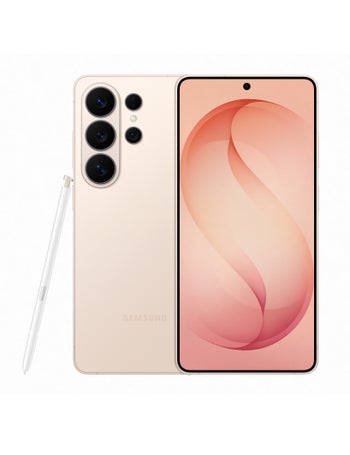
|
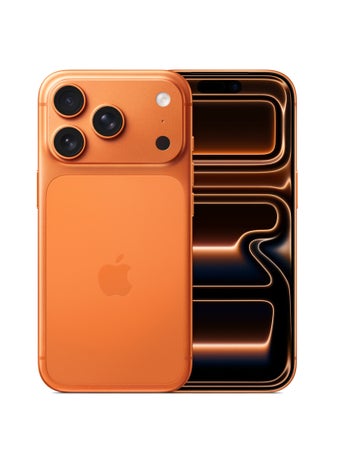
|
| Samsung Galaxy S26 Ultra | Apple iPhone 17 Pro Max |
| Dimensions | |
|---|---|
| 163.6 x 78.1 x 7.9 mm (~10 mm with camera bump) | 163.4 x 78.0 x 8.75 mm (~9.9 mm with camera bump) |
| Weight | |
| 214.0 g | 233.0 g |
| Size | |
|---|---|
| 6.9-inch | 6.9-inch |
| Type | |
| Dynamic AMOLED, 120Hz | OLED, Variable 1-120Hz |
| System chip | |
|---|---|
| Snapdragon 8 Elite Gen 5 SM8850-AC (3 nm) | Apple A19 Pro (3 nm) |
| Memory | |
| 12GB (LPDDR5X)/256GB (UFS 4.0) 12GB/512GB 16GB/1024GB |
12GB/256GB 12GB/512GB 12GB/1TB 12GB/2TB |
| Type | |
|---|---|
| 5000 mAh | 5088 mAh |
| Charge speed | |
| Wired: 45.0W Wireless: 15.0W |
Wired: 40.0W Wireless: 25.0W |
| Main camera | |
|---|---|
| 200 MP (OIS, PDAF) Sensor name: Samsung ISOCELL HP2 Aperture size: F1.4 Focal length: 23 mm Sensor size: 1/1.3″ Pixel size: 0.6 μm |
48 MP (Sensor-shift OIS, PDAF) Aperture size: F1.8 Focal length: 24 mm Sensor size: 1/1.28″ Pixel size: 1.22 μm |
| Second camera | |
| 50 MP (Ultra-wide, PDAF) Sensor name: Samsung JN3 Aperture size: F1.9 Sensor size: 1/2.5″ Pixel size: 0.7 μm |
48 MP (Ultra-wide, Sensor-shift OIS) Aperture size: F2.2 Focal Length: 13 mm Sensor size: 1/2.55″ Pixel size: 0.7 μm |
| Third camera | |
| 10 MP (Telephoto, OIS, PDAF) Sensor name: Sony IMX754 Optical zoom: 3.0x Aperture size: F2.4 Sensor size: 1/3.94″ Pixel size: 1.12 μm |
48 MP (Telephoto, Periscope, OIS, PDAF) Optical zoom: 4.0x Aperture size: F2.8 Focal Length: 100 mm Sensor size: 1/2.55″ Pixel size: 0.7 μm |
| Fourth camera | |
| 50 MP (Telephoto, Periscope, OIS, PDAF) Sensor name: Sony IMX854 Optical zoom: 5.0x Aperture size: F2.9 Focal Length: 115 mm Sensor size: 1/2.52″ Pixel size: 0.7 μm |
|
| Front | |
| 12 MP (PDAF, HDR) | 18 MP (Time-of-Flight (ToF), Autofocus, HDR) |
Samsung Galaxy S26 Ultra vs Apple iPhone 17 Pro Max specs comparison
or compare them to other phones using our
Phone Comparison tool
Also read:
Summary
Just like the iPhone 17 Pro Max did for Apple, the Galaxy S26 Ultra has introduced few but key upgrades that will make it a notable new release for Samsung.
We are getting improvements to the display and performance, as well as the camera and the charging speeds. Sure, the battery has not scored an upgrade for yet another year in a row, but we hope the efficiency of the Snapdragon 8 Gen 5 helps achieve better battery life.