

The Evergreen Essence of Chak De! India directed by Shimit Amin
Country: India | Runtime: 153 minutes | Genre: Sports
I remember as a child, whenever ‘Chak De! India’ played on the television, I would most likely end up spending the next few hours watching the film without fail. The moment that I would await for the most would be a scene where the Indian women’s hockey team are taken out for lunch on their coach’s final day before he is to leave. A massive brawl breaks out after a few men pass unsavoury comments towards a few of the players. The scene develops in such a way that there is an intensity that keeps you constantly rooting for the team, who ultimately find a sense of togetherness that they seemed to lack for so long. It is in this singular moment that Chak De! India became one of my favourite films growing up, and that is not to say that the rest of the film is not filled with glorious moments. Who can forget the iconic penalty shootout sequence, which makes time stand still, each second seems to feel like an eternity itself?

Yes, the film does center around the protagonist who is a male coach, but the true heart of the film lies in the story of the team players of the Indian women’s hockey team. Chak De! India was a film that was born out of observation and alarming fear. Jaideep Sahni, the masterful screenwriter, came across a short newspaper article that covered the victory of the Indian women’s hockey team at the Commonwealth games in 2002. Upon further uncovering, he was shocked at the state of sporting infrastructure for women.
The title itself is inspired by a martial cry that Sikh soldiers often would shout out loud while lifting logs to build bridges at the time of war campaigns. The way “Chak De!” is used in the film is not only fitting, but deeply moving, and can give one goosebumps.
The film captures the spirit of India through its representation from across the country. The players may be from different states, but as Coach Kabir Khan (played masterfully by Shah Rukh Khan) says, their nationality as Indians comes first before anything else. The group of women are at first not at all in a spirit of togetherness and the seemingly vengeful coach, who is labelled as a traitor attempts to seek a sense of unity amongst the group. His strictness is balanced by a deeper sense of humanity that comes through in poignant moments throughout the film.
The film shows the gender dynamics and dismissive nature of men towards women in sports, which only fuels viewers further to root for the team to prove not just their fellow countrymen, but the entire world wrong.
Also Read | Protecting women’s rights amid conflict and instability
The film is a household name that has had a unanimous effect on people, pushing them to fight for their dreams and push back against all forces, jumping over the hurdles of disrespect and lack of belief. The film approaches its subject with great sensitivity and allows viewers to truly humanise and connect with the players in the team. Every single character is deeply distinct- An original voice. They all face problems caused by outside forces that they are surrounded by- If one is a victim of casual misogyny, then another is a victim of racism and sexual harassment. Amidst their tragedies there also is a disbalance caused by their own lack of chemistry as a team. Yet they must find a way to persevere and operate as a team. In doing so, they manage to induce hopes in ways that not just change their fate, but result in the making of a cinematic work that has been and will remain cherished for decades to come at the very least.
“Hidden No More” – Hidden Figures directed by Theodore Melfi
Country: USA | Runtime: 127 minutes | Genre: History / Drama

The cast of the movie ‘Hidden Figures’.
| Photo Credit:
Wikimedia Commons
Caution meets a certain sense of cheesiness in Theodore Melfi’s historical drama about three human computers who were instrumental in the operations of NASA during the space race between the United States and Soviet Union in the 1960s. That does not, however, necessarily take away the emotional and thematic core of Melfi’s drama, which is bolstered by three impeccable performances by the lead actors. Taraji P. Henson’s central role as the gifted mathematician Katherine Gable Johnson sets the basis for a story that moves like a car chase during moments showcasing personal life, while moving at a much steadier pace during the moments that shaped history inside the NASA building.
It is interesting to notice how while the global picture was focused on outer-worldly pursuits, America itself lay in utmost turmoil. Racism, as normalised as the act of drinking water, was a battle that not just the three leading women, but millions in the country were fighting on a daily basis. Added to this, a blatant sexism exists in the mannerisms of daily conversation that is further aggravated by the racist mind prevalent even in an institution that saw some of the smartest minds from around the world step into its building. Amidst their personal battles, the three women must find a way to focus on the global battle equally, if not more. This is a spot where Hidden Figures comes short and finds itself taking several liberties in storytelling, be it in the form of its often shortened sequences that leave you wanting more, or the sometimes too overtly-simple moments that seem downright uncharacteristic in a bureaucratic institution. The film does however, find its heart in the right place, and the emotional core lights up brightly.

“Math is always dependable”, says Katherine during a key moment in the film. She is not only a gifted mathematician, but also a sharp-tongued woman who knows to say the right thing at the right time, and battle for righteousness. While Katherine focuses on the Space Task Group, Dorothy Vaughan (played by the ever-brilliant Octavia Spencer) finds herself understanding the latest replacement to human computers, the IBM better than anybody else. Dorothy wants a promotion, she knows she deserves it more than anybody else. Mary Jackson (Janelle Monae) is as much a natural engineer as she is a fighter, living in an era where women weren’t allowed to be engineers. Mary must break the norms, she must fight. They must change history.
Mathematics, like the universe is vast, is ever-expanding, and sometimes, we need to know how to balance the act of discovering the new and finding new in the old. As much as Hidden Figures is a film about mathematics, it is equally a film about chemistry as well. It is a film that thrives on the chemistry between every single actor in it, and in that very process, it not only celebrates womanhood, but echoes the short-sighted sexism that existed (and still does) at workplaces, where purely on assumptions women are undermined. The dynamics between the three friends (and colleagues) feels extremely natural- They know when to up the antics and when to find restraint.
While the film as I mentioned, manages to make NASA seemingly not bureaucratic and has a rather short exposition when it comes to the personal lives of the women, the book it is based on (goes by the same name as the film) provides a much more detailed narrative of the same for those interested in understanding a pivotal moment in history and three people whose integral contributions helped shape it.
The title of the film itself works interestingly, and by the end of the film, it becomes polysemous. It is a film where mathematics is a means of exploration, and provides the viewer an understanding (even if not in extreme depth) of the scope of math, and the limitlessness of it. Through Katherine, Dorothy and Mary’s determination, we realise through the film that even though unseen, the three women who fought against the various systems that would prevent them from having any voice, ultimately serve as the backbone for the United States during the pivotal historical moment that was the space race.
“She is The Fury” – Polite Society directed by Nida Manzoor
Country: United Kingdom | Runtime: 104 minutes | Genre: Action / Comedy
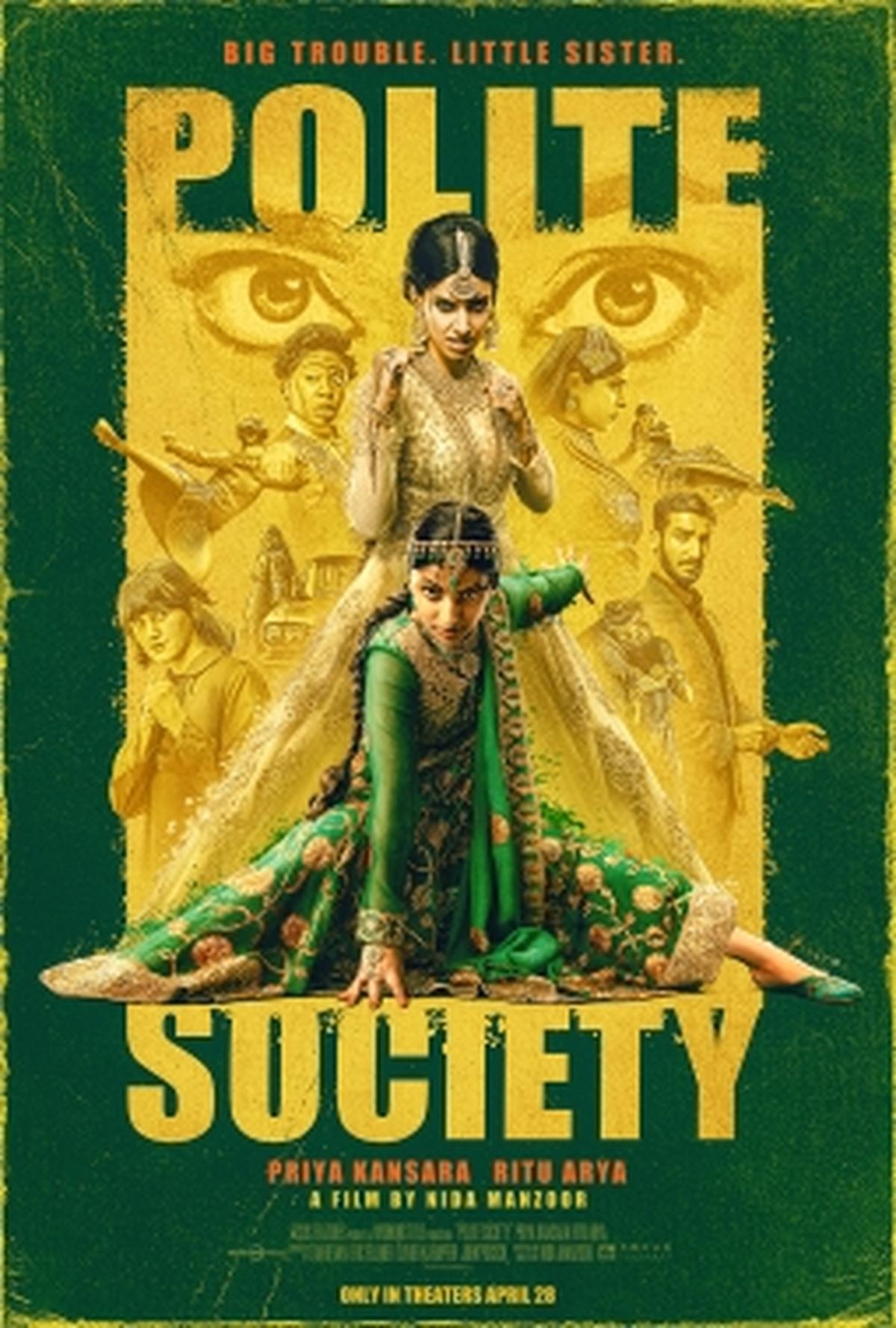
The movie poster of Polite Society.
| Photo Credit:
Wikimedia Commons
Unapologetically energetic and ridiculously funny from the very get-go, there is so much style in Nida Manzoor’s ‘Polite Society’, a satire-comedy destined to go down as a cult-classic British film. High-School student Ria Khan dreams to be a stunt performer at the movies. For her, there is a glory in doing what many may fear to do. Her soon-to-be-married older sister is her in-house part-time cinematographer, and full-time best friend. The closeness between that they share is perhaps in some sense an outcome of still being seen as immigrants to a certain degree by those around them.
Ria’s older sister, Lena, is soon to be married to Salim, who leads a life of utmost luxury. Ria’s shock arrives when she realises her sister is willing to forget pursuing her dreams and move to Singapore with a man she has known only for a few weeks. Feeling like something is off, she begins spying on Salim. Added to this, Ria’s dreams are too constantly being taken unseriously by the adults around her (besides her sister), and she fails to get a response from the several mails she sends to a stuntperson who is her idol.
The film manages to strike a balance in its two core themes through the use of satire. There seems to be something deeply unsettling yet true in the behaviour of the uber-rich, who wrongly use their social positions to indulge deeply inhumane activities. At the same time, Polite Society captures an awkward year of a teenager who thinks she’s got it all figured out, until she quickly realises she hasn’t. Ria’s naivety towards her worldview very quickly changes when she finds out certain truths that she must exist alongside, which in the context of real life too seems all too true. However, there is a hope to not lose the innocence that we grow up with, for it is that very nature in us that keeps us alive.
The action sequences in this film are supremely fun to watch, and that is owed to the stylistic choices the film makes, which furthermore makes you love the characters and the journey they undergo. ‘The Fury’, as Ria likes to call herself, is all kicks and punches to the confines of an overbearing society.
The dense story ties up together at the end; Polite Society through its satirical story captures a sibling-story that is as heartfelt as it is humorous.
Dhunu’s dreams – Village Rockstars directed by Rima Das
Country: India | Runtime: 87 minutes | Genre: Coming-of-age

A still from the movie Village Rockstars.
| Photo Credit:
Special Arrangement
There is so much heart and heartbreak in Rima Das’ ‘Village Rockstars’, a truly tender telling of a story that holds within the boundaries of its O’Henrian irony an equally powerful tale of coming-of-age.
Dhunu is 10, and she dreams of becoming a rockstar the moment she sees a band perform at a function. She cannot afford to purchase a guitar, so she does the next best thing possible: she makes one out of thermocol. This new guitar very quickly becomes her whole world, and in some sense a way to escape as she wanders through the vast landscape of Kaladriya, her village in Assam.
Dhunu must also equally play the dutiful daughter to her widowed mother at home, as she takes cows and Munu, their pet goat to graze in the nearby fields. She often spends her time with the boys from her school in the village, and quickly realises the need to save up money to buy a real guitar someday.
Nature plays its part
Every frame is tenderly composed, with a stunning use of natural light. The vast expanse of nature invokes a certain sense of freedom, and the longing for it at the same time. Amidst many things, it is a film about a mother and daughter, and equally a film about a young woman trying to understand the world around her, and the life that has shaped her to be who she is. She may not hold the same innocence at the age of 20 that she does at the age of 10, who is to know? All we know is Dhunu dreams, and Dhunu discovers womanhood in all of its glory.
The film also sets a backdrop of the floods that cause destruction in Assam, and how that equally is inevitably a part of the character’s life. This is further seen towards the final act of the film, which remains one of Indian cinema’s most poignant endings in recent times.
Rima Das’ journey as a film-maker itself is inspiring, and her body of work craves more and more eyeballs. Her deeply human and emotional approach towards capturing the lives of people reminds one to always look around the world we live in, and to consider that there aren’t merely stories around us, but life everywhere, which in all of its gruelling hardship and unforgiving glory, must go on.
A girl’s quest for freedom – Persepolis directed by Marjane Satrapi and Vincent Paronnaud
Country: Iran | Runtime: 96 minutes | Genre: War / Comedy
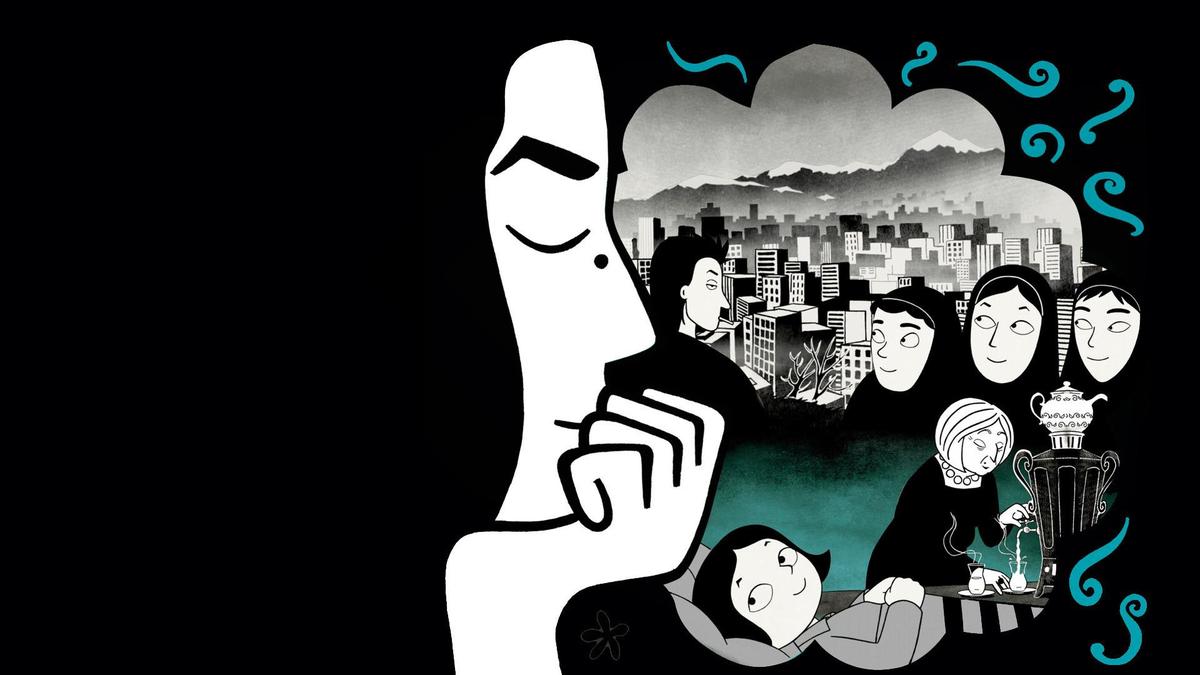
A graphic novel turned animated masterpiece, ‘Persepolis’ is harrowing yet hopeful; poignant and personal
| Photo Credit:
Special Arrangement
There aren’t as many films that make you feel “Punk is not dead” quite like ‘Persepolis’. Marjane grows up in an Iran full of conflict and revolution. From her youth, she is witness to people being jailed and hearing news of executions of those who choose to stand against the power with a voice of reason. In the vast expanse of thought-processes that she is surrounded by, young Marjane’s mind is moulded by what goes on around her. However, her intrigue gives rise to a conscience that is fuelled by those closest to her.
Deep, personal story
Adapted from Marjane Satrapi’s book of the same name, the graphic novel too follows a similar style of artwork. The book itself is all-too powerful and a must-read. The deeply personal story begins with the world that shapes Marjane but soon becomes one that seeks to understand Marjane and her life. She struggles to fit into new spaces which promise protection to her, and amidst the several hardships, she never lets go of the golden words that her grandmother (the coolest mentor you’ll see) tells her before she leaves for Vienna to continue her school.
Satrapi grew up at the time of the Shah’s downfall, and was first-hand witness to the fundamentalist rule that soon followed in Iran. The first-hand narration of life for women under these circumstances and their silent revolution amidst the louder one outside brings with it equal rage as it does the feeling of helplessness. The struggles of being an immigrant even in spaces that are accepting eventually seep into Satrapi’s life and even upon her eventual return to Iran, she finds herself unable to fit into a country that has radically changed over the years.
There’s hope nevertheless
Her familial support is immense, and while the film’s dismal tone conveys all one needs to know about the political conditions under which the women of Iran live under, there is a hope in the film’s undertone that seeks to always ask questions, and take a stand against what one feels is fundamentally wrong and untrue. History often is shaped by those who are in power, and Persepolis highlights it with a childlike innocence which slowly breaks as Marjane grows older.
As she discovers herself through the years, we slowly go more and more into her psyche and at some point, we find ourselves being a companion on her journey throughout. There is a constant fear as to what can go wrong in the land of authority, where respect is demanded and rules are meant to be followed baselessly. There is a sense of ridiculousness in how one-sided the rules seem to be, which cater very specifically to a gender norm. To doubt them leads to being silenced.
Persepolis reminds us that respect is earned, and that in this cruel, unforgiving world, we must seek to ask questions, to challenge notions and stand together in unity, rather than aiding a constant divide that seeks to put a very specific few in power.
Never too late to start anew? – English Vinglish directed by Gauri Shinde
Country: India | Runtime: 134 minutes | Genre: Comedy / Drama

‘English Vinglish’ is the journey of self-discovery of a home-maker.
| Photo Credit:
Special Arrangement
Life comes with liberations of many kinds, and at the time of watching ‘English Vinglish’, it felt to me like a film full of empathy amidst chaos of the unknown. Shashi travels to the U.S. for the first time, all alone. She neither understands English, nor does she know how to speak it. An individual placed in a completely new space, she decides to attend English classes while she is there.
Language as a metaphor
There is so much to admire in the film’s careful observation of the characters, and how each and every one of them seem to be distinct individuals. As Shashi navigates through the process of learning English, it works as the perfect metaphor for her own journey of self-discovery. She begins to feel a sense of burden being slowly lifted as she gains clarity in a language. In the meantime, her relationship with her family, who are not yet in America, seem to be the same as always — with several tiffs and arguments with people who seem to have taken her years of effort for granted.
Gauri Shinde employs humour to allow breathing spaces in a film that asks a very important question: “Can we start all over again in our 40s?”
Choose empathy
Sridevi’s confused state of mind that slowly finds itself connecting to the world around her is perfectly captured in her performance, her nuanced expressions and body movements aid to what makes for the heart of the film.
The final sequence bears so much meaning and feels truly heartfelt, it is a reminder that in a world where we are so quick to be judged for our inabilities, we can choose to remain empathic and find hope in the silences between spoken words.