
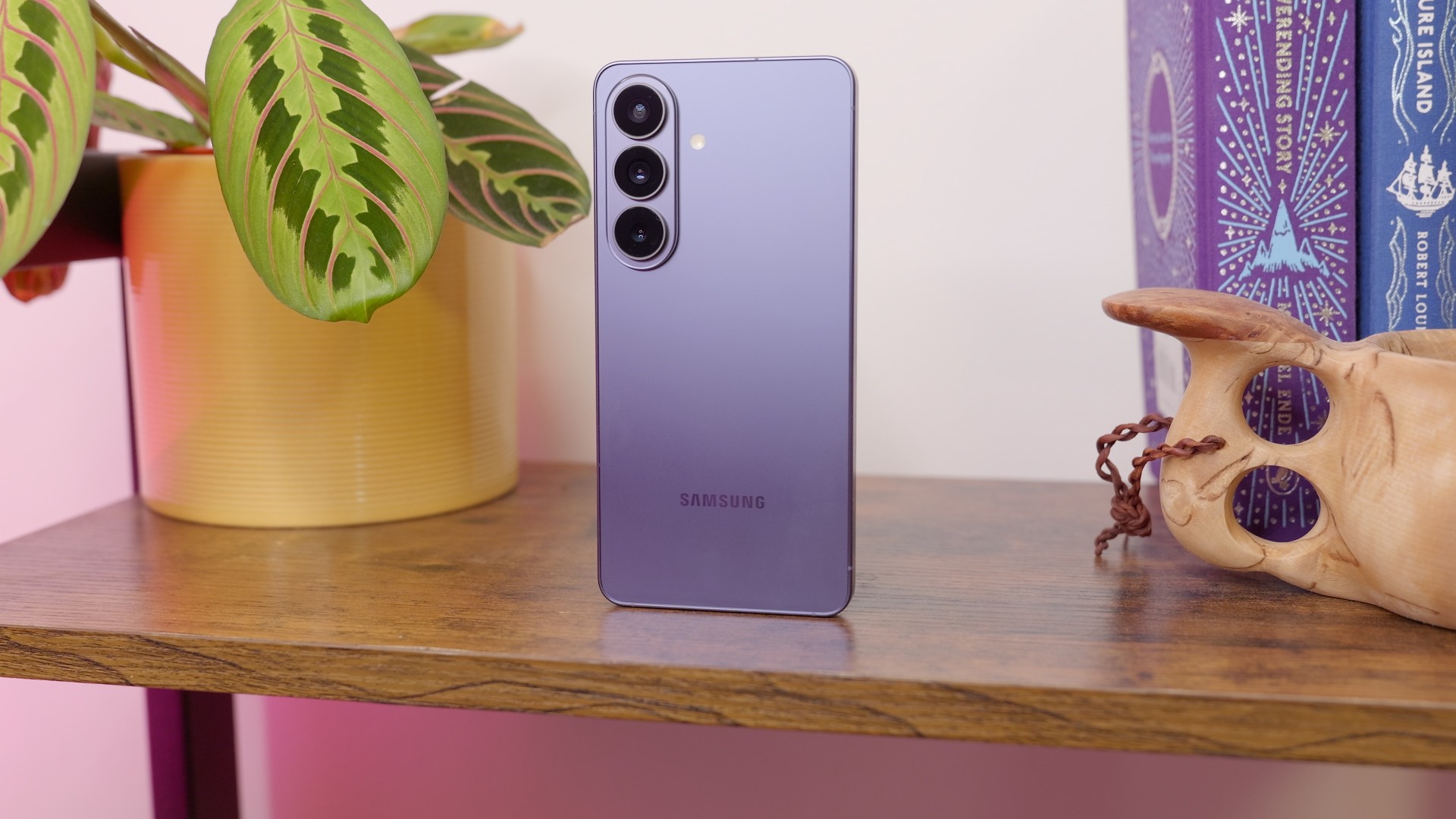
Verdict
The Galaxy S26 is a slim, lightweight flagship with an excellent display and strong performance, but only modest upgrades over last year. Its camera and battery are good rather than class‑leading, yet still make it one of the best all-round Android phones. Unless you get a great deal on the S26, a discounted or refurbished Galaxy S25 will offer a very similar experience for less.
-
Bright and vibrant display -
Super fast and responsive performance -
Compact, thin and lightweight
-
Camera performance is solid but not mind-blowing -
Battery life isn’t the strongest around -
Not much change from the Galaxy S25
SQUIRREL_PLAYLIST_10208273
Key Features
-

Review Price: £879 -
Compact design
At 7.2mm thick and 167g, the Galaxy S26 is a true example of a compact smartphone. -
Plenty of AI smarts
With a range of new features under the Galaxy AI roster, the S26 can do some impressive stuff. -
Oodles of power
It may not be the Snapdragon 8 Elite Gen 5, but the Exynos 2600 can hold its own in many respects.
Introduction
There’s an old folk tale about an emperor so bored with his existing clothes that a couple of con men trick him into thinking he has a brand-new set of clothes that’s only visible to wise people.
The catch? There aren’t really any new clothes, yet he struts around naked and pretends to see them to save face.
Except in the story of the Galaxy S26, it feels like I’m the emperor, and I’m being told this is new, when in reality, it doesn’t really feel like it is.
Design
- Compact and lightweight
- Slight design tweaks compared to S25
- Durable and water resistant
It’s worth noting at this point that I don’t think for one second we’re being conned by Samsung here. It’s more an indication that we’ve got about as far as we can get when it comes to features and performance in a small-ish Android phone.

That said, there is a bit of refinement in the design department, pushing things further in that direction without making any significant changes from last year.
The already skinny bezel is now just the teensiest bit skinnier around the display, and the phone camera now lives in a raised pill-shaped island rather than just poking awkwardly out of the rear panel.

For those averse to phones that wobble on your desk or table, it’s one to avoid. Placed on its back, it’s the wobbliest phone I’ve used in a while.
Still, at 7.2mm at the edges, it’s as impressively slim as the S25 was last year. And it’s one of the few flagship phones on the market that’s just about compact enough to use one-handed pretty comfortably.

Otherwise, there’s not much to see. It’s a sleek, flat-edged phone made of aluminium and Gorilla Glass Victus 2. It’s also IP68 rated against water and dust, as most Samsung flagships have been for a few years now.
Screen
- 6.3-inch 120Hz AMOLED screen
- Missing key S26 Ultra features
- Very bright and pleasant to use
One point of distinction – apart from the size difference – between this regular Galaxy S26 and the more expensive S26 Ultra is the technology behind the display.

You don’t get the super anti-reflective coating on the 6.3-inch S26, and neither do you get the Privacy Display tech that can block out parts of the screen for anyone viewing it at an angle.
Still, it’s one of the best, most vibrant and fluid displays you’ll find on the market. Paired with the precise haptics, it leaves me with the impression that I’m using a very good phone.

Whether or not it’s any better than last year’s one, I can’t be 100% sure. But with a peak brightness of 2600 nits, it can produce very bright spots in HDR video content. And it can be cranked up brightly enough to cut through any bright daylight or ambient light, so visibility is rarely an issue.
Software and AI
- OneUI 8.5 based on Android 16
- Plenty of AI features, not all useful
- Seven years of OS upgrades
Samsung has gone all in on AI with its latest software. To the point where it’s telling us the Galaxy S26 series aren’t smartphones, they’re AI phones. To me, that should herald a big change in the user interface, or make AI a more pervasive part of the experience. And to an extent, it has been. But I couldn’t really tell.
Perhaps it’s just me being stuck in my routine for using a phone, but I can’t say it’s made a massive difference to how I personally use it.

A big part of the change has been to make Bixby, Samsung’s assistant, more natural to communicate with. And it can be useful when you want to change settings, like switching on your eye comfort mode to reduce glare at night.
I’d argue, just like I do most times when it comes to AI, that the most useful AI features are the ones that help you do what you’re already doing with the phone, but make it better. Smart features like the AI noise eraser, for example, that erases background noise from videos you’ve recorded and can now work in apps like YouTube to reduce backing tracks or background noise, to let you focus on the voice and dialogue.

It works surprisingly well in real-time as you’re playing the video. And you get to customise how strong you want the audio eraser to be. It doesn’t completely get rid of the background sounds, but it does enough to enhance the voice that’s speaking. It’s useful if your favourite YouTuber has distracting background music throughout the video, or for reducing crowd noise during football highlights, which can be overwhelming for some.
Samsung’s AI efforts are supposed to be more contextually aware of everything that’s happening on your device too. We keep hearing talk about ‘Agentic AI’, which is effectively when AI is your personal agent, who knows your entire calendar, has read your messages and can help make organising simple. So, for instance, if you’re arranging to meet up with friends in a WhatsApp chat, it should be contextually aware enough to offer suggestions based on those messages.

But sadly, it wasn’t something that was ever all that useful for me, and never showed up. Examples I’ve seen from other tech reviewers also showed it getting things hilariously wrong, trying to organise a get-together in San Francisco when, in fact, they were based in London.
Performance
- Exynos 2600 in UK, Snapdragon 8 Elite Gen 5 in the US
- Solid performance in day-to-day use
- Can handle light gaming sessions well
Typically, when you opt for a smaller phone, you get reduced performance from phones due to there being less space for heat to dissipate. With the S26, I never struggled.
Even though my unit had Samsung’s own Exynos 2600 processor in it, it scored well in all my tests, and even benchmarked strongly against the Snapdragon 8 Elite Gen 5-equipped Ultra variant.

Granted, the screen has a lower resolution than the Ultra, but it could still maintain solid frame rates during extended use. And given that the display is smaller than the Ultra’s, it never felt as though extra pixels to make it sharper would be beneficial.
Samsung’s One UI software seems well optimised for fluid and smooth responses too. It wasn’t unnaturally fast, but interactions and the resulting on-screen animations were usually instant, with zero lag or delay across the user interface.
Gaming was similarly lag-free. Playing my usual favourite, Mario Kart Tour, it maintained high-resolution gameplay and smooth frame rates without really troubling the processor at all. It was also rare for me to feel the phone heat up during use, not in any troubling way at least.

So if you’re after a small phone that can keep up with pretty much anything – this is it. I would be curious to test a Snapdragon-powered variant against it to see if there’s a disparity in performance between the different models.
Battery life
- 4300mAh battery
- Average battery life
- Qi2 wireless charging without magnets
Samsung increased the battery capacity on the latest entry-level Galaxy S phone, and about time too. At 4300mAh, however, it’s still some 600mAh short of the Google Pixel 10’s near-5000mAh capacity.
Still, my experience with it has led me to believe that if you’re a relatively light user who rarely goes for more than 3-4 hours of screen time in a day, you should be able to get through the day on a full charge.

For me, personally, it was never a problem. I am a relatively light user who lives in an area with no 5G coverage, and no hugely busy built-up urban environments, so even when I’m out and about, the actual background drain isn’t high. At least, not as high as it would be in somewhere like London.
I couldn’t even quite get it to last two full days unless I barely used it, but on one of my busier days, I did still have about 40 percent of the battery left at bedtime after taking it off charge around 8am in the morning and using it during the day for benchmark testing, cameras, gaming, WhatsApping and social media.

If you’re the type of person who regularly drains your phone before the end of your workday, I can’t imagine this will be any better for you. Bigger phones, especially those from the likes of Oppo and OnePlus, will get you much more mileage than any of Samsung’s current offerings, as Samsung goes all-in on thin/light phones.
Cameras
- 50MP main, 10MP telephoto and 13MP ultrawide lenses
- Fine camera performance, but not the best
- Main camera is the best of the bunch
I think it’s safe to say the camera system on the regular Galaxy S26 is starting to feel a little weak and dated. While the primary camera is pretty strong in most conditions, the other two cameras joining it haven’t really been improved in a few years, at least not in any meaningful way. And so they’re still relatively small and pretty low-resolution for what you’d expect from a fairly expensive phone.

The 3x zoom camera is good in some specific scenarios. It can be an effective camera for taking close-up macro shots in bright conditions, and is good for portrait shots of people and pets. It sometimes struggles to completely lock in the focus, and so if an object is moving slightly in the wind, it might just look a tiniest bit blurry. And while it does contain really bright highlights pretty effectively, it’s not quite as good as the main camera at those.
Still, it can’t zoom as far into a scene as the Pixel 10, which has a 5x zoom camera. And because it’s only a 10-megapixel sensor, digital cropping isn’t as effective as with some competitors that use higher-resolution sensors and let you digitally push farther into the scene for closer shots of faraway objects.
The ultrawide camera is definitely the weakest of the bunch, however. It’s fine in bright conditions that aren’t too challenging, but as soon as scenes are complicated by bright backlighting or low light, the image quality drops significantly. I often found the pictures pale, grainy and just generally quite rough-looking. Particularly towards the edges of the frame, where it also distorts.
In fact, a lot of the time, the ultrawide results reminded me a little of the image quality you’d get on a more affordable phone. It certainly doesn’t seem quite high enough quality to be a top-tier device. It struggles in night mode too, with the stabilisation not quite effective enough to completely eliminate hand motion/shakiness every time.
Still, overall, the system is consistent and pretty strong. I do like how, in heavily backlit scenes where HDR is required, it doesn’t completely lift the shadowed areas, making them pale and foggy, as you’d see on some other phones. It lifts the darker parts but still keeps it looking shadowed, maintaining the separation between the bright and dark parts of the image. And the colour processing is consistent across the three lenses too.
Samsung’s processing is generally quite vibrant. Blues and greens, in particular, when shooting landscape shots are quite saturated, but no longer to the point where it looks artificial.
The night mode algorithm kicks in automatically when the light levels drop enough, and Samsung’s algorithm is strong enough that it can capture all the light it needs in a couple of seconds. Again, you’ll see quite strong, saturated colouring if there are any artificial coloured lights in the scene. And again, the image quality from the main sensor is stronger than from the ultrawide and the zoom.
One thing I can praise the Samsung camera for is how easy it is to use. The whole time I was testing it, I could just point, tap to focus and shoot, and the photo would be captured quickly and, most of the time, reliably. Despite my criticism of the zoom and ultrawide being weaker than I’d like, I think it’s a system that’ll suit most people just fine.
SQUIRREL_PLAYLIST_10208273
Should you buy it?
You want a compact, powerful smartphone
With a 6.3-inch screen, a 7.2mm-thick chassis and Exynos 2600 power, the S26 is a little pocket rocket.
You want the best cameras or battery life
The S26 cameras are fine, but not mind-blowing for the price, and the 4300mAh battery similarly trails behind the competition.
Final Thoughts
In the end, I’m a little torn with the Galaxy S26. There’s no doubt to me that if you want a flagship phone that’s thin and light, with solid performance and a decent camera experience, the Galaxy S26 is probably still the best all-rounder. But then there’s that realisation that it’s because there’s very little competition for it.
Pixel phones are thicker, with less powerful processors and smaller displays, while the regular iPhone has a more limited camera system. Beyond those two, there’s not much in the way of competition for the S26, and so Samsung can keep on with the incremental upgrades without going all-out to compete, safe in the knowledge that, despite the fact it could be better, it doesn’t need to be.
A case of the emperor’s new clothes, it may be, but when the clothes are perfectly fine as they are, why update them too much?
Putting my consumer advice hat on for a second, however, as safe a purchasing choice it is, I’d argue it makes more sense to buy last year’s Galaxy S25 instead if you can find a good discount on it, or a refurbished model in very good condition because you really wouldn’t be missing out on all that much if you got that instead of the new model.
How We Test
We test every mobile phone we review thoroughly. We use industry-standard tests to compare features properly and we use the phone as our main device over the review period. We’ll always tell you what we find and we never, ever, accept money to review a product.
- Used as a main phone for over a week
- Thorough camera testing in a variety of conditions
- Tested and benchmarked using respected industry tests and real-world data
FAQs
Samsung has committed to seven years of OS upgrades for the Galaxy S26.
While it technically has 25W fast charging, it’s far behind the 45W and 60W of the S26 Plus and S26 Ultra.
Test Data
| Samsung Galaxy S26 | |
|---|---|
| Geekbench 6 single core | 3139 |
| Geekbench 6 multi core | 10729 |
| Geekbench 6 GPU | 25103 |
| 3DMark Solar Bay | 50.9 |
| 3D Mark – Wild Life | 6018 |
| 3D Mark – Wild Life Stress Test | 64.4 % |
Full Specs
| Samsung Galaxy S26 Review | |
|---|---|
| Manufacturer | Samsung |
| Screen Size | 6.3 inches |
| Storage Capacity | 256GB, 512GB |
| Rear Camera | 50MP + 10MP + 12MP |
| Front Camera | 12MP |
| Video Recording | Yes |
| IP rating | IP68 |
| Battery | 4300 mAh |
| Wireless charging | Yes |
| Fast Charging | Yes |
| Size (Dimensions) | 71.7 x 7.2 x 149.6 MM |
| Weight | 167 G |
| Operating System | One UI 8.5 (Android 16) |
| Release Date | 2026 |
| First Reviewed Date | 12/03/2026 |
| Resolution | 1080 x 2340 |
| HDR | Yes |
| Refresh Rate | 120 Hz |
| Ports | USB-C |
| Chipset | Samsung Exynos 2600 |
| RAM | 12GB |
| Colours | Cobalt Violet, Sky Blue, Black, White, Silver Shadow, Pink Gold |
| Stated Power | 25 W |