
Verdict
The Samsung Galaxy S26 Plus offers the series’s slick feel, smart design and all-round great photography experience. It may not be hugely ambitious on the tech front, but the day-to-day experience tempers the lack of progress here.
-
Slick and responsive
-
Slim and good-looking screen surrounds
-
High quality, fun-to-use camera
-
Excellent speakers
-
Mediocre battery life
-
Similar to last year’s version
SQUIRREL_PLAYLIST_10208274
Key Features
-

Review Price:
£1099
-
Stereo speakers
The phone has unusually good stereo speakers, which are ideal for casual listening at home.
-
3x zoom camera
We don’t get the mega zoom of the Ultra, but the Plus’s 3x zoom is still handy.
-
6.7-inch OLED screen
Bright, sharp and fairly large, the screen is a great canvas for YouTube and Netflix.
Introduction
Your view on the Samsung Galaxy S26 Plus may well be determined by how into tech you are.
It’s a fairly conservative update to the Galaxy S25 Plus, and lacks the more eye-opening features of the Galaxy S26 Ultra. But does that really matter to the average buyer who may be upgrading from something three years old, or even more past-it?
Taking that view, the Samsung Galaxy S26 Plus delivers a great overall experience. Camera quality and overall responsiveness are key highlights. Samsung continues to lag behind in battery tech, though. It’s no longer just about Samsung’s relatively slow charging, but lower overall capacity too.
When rivals like the Oppo Find X9 Pro have 1.5 times the battery stamina with only an extra millimetre of thickness, you may have a problem on your hands.
Price and Availability
The Samsung Galaxy S26 Plus is the middleweight of the Samsung 2026 higher-end phone line-up. It starts at £1099 before any discounts, and you’ll pay £1269 for the version with 512GB storage instead of 256GB.
Before jumping on that upgrade, consider you can also get the Samsung Galaxy S26 Ultra (256GB) for a similar £1279. But you can also pay a heck of a lot more for one of those: £1449 (512GB) or £1699 (1TB, 16GB RAM).
All of these phones were announced in February 2026, around the time of the Mobile World Congress show.
Design
- Slim squared-off design
- Corning Victus 2 glass and aluminium
- Slim screen borders
The Samsung Galaxy S26 Plus is the middle kid in the high-end Galaxy line-up for 2026. It’s not small like the standard Galaxy S26, but it’s not ludicrously feature-packed like the Galaxy S26 Ultra.
That’s not going to win you too many points among the most tech-obsessed. It also looks very similar to last year’s Galaxy S25 Plus.
But are many ordinary folks really going to be upgrading phones this pricey on an annual rotation? I’d hope not.

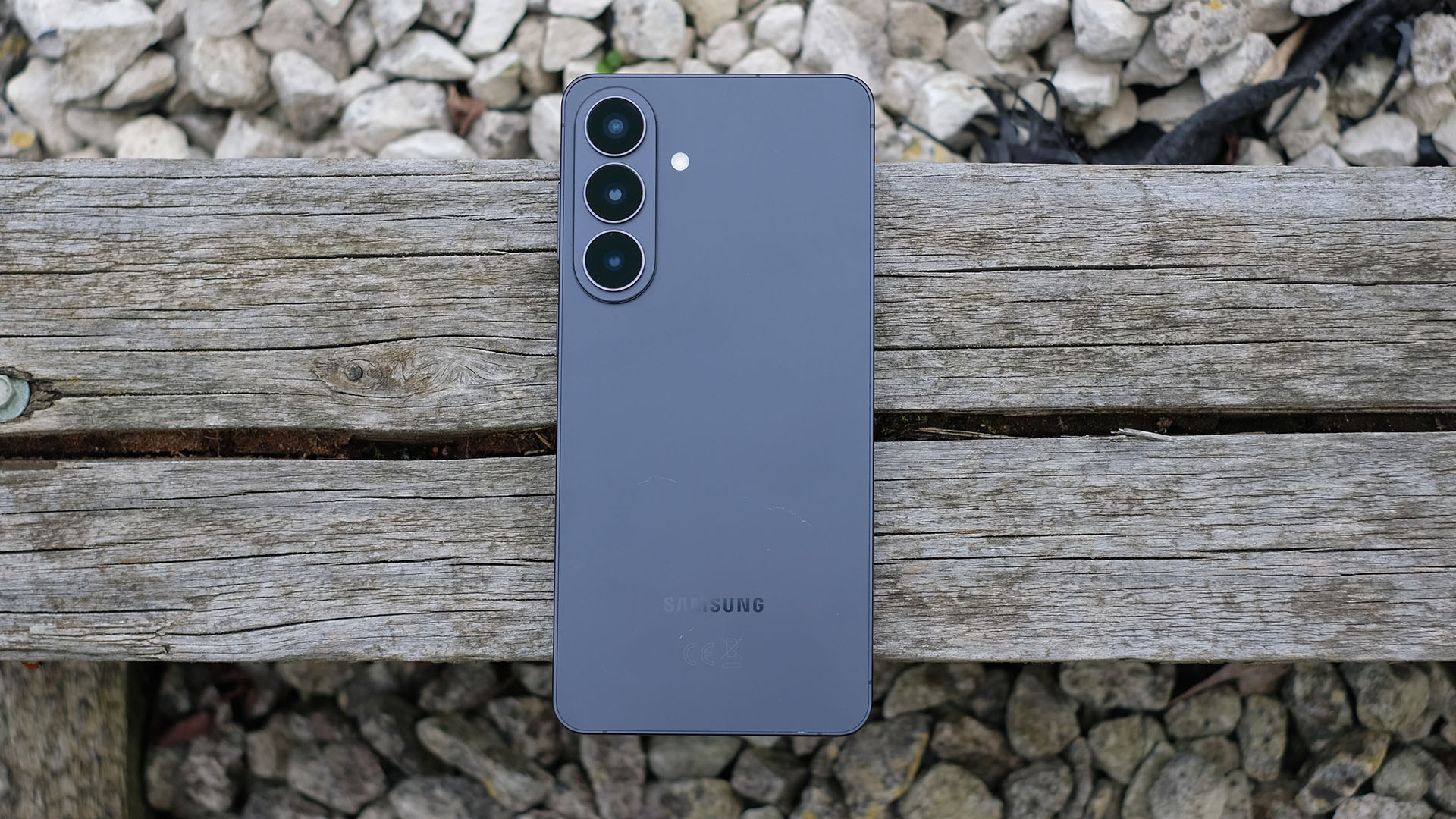
The Samsung Galaxy S26 Plus’s design win is that you get loads of screen per square centimetre of footprint, thanks to its very thin screen borders. They are unusually consistent across all four sides of the phone too, giving it a pleasant minimalist look.
It feels slim too, despite having squared-off sides that don’t remotely mask the phone’s dimensions.
You’re probably going to want to ruin all of that with a phone case. The Samsung Galaxy S26 Plus uses top-tier Corning Victus 2 glass on front and back, with a lovely frosted finish on the rear. But nothing’s immune to scratches or cracks. The sides are aluminium.

As usual, Samsung does not supply a case, and there’s no screen protector. Consider ordering those alongside the phone.
Just like last year, the Samsung Galaxy S26 Plus has excellent water resistance, IP68 class, meaning it can be fully submerged in water, no problem. The speaker will just sound weird for a while afterwards. And, business as usual, there’s no headphone jack, no expandable memory.

The Samsung Galaxy S26 Plus speakers are excellent, though. They project well, are loud and sound full-bodied, giving weight to podcasts — perhaps stick to a Bluetooth speaker for music if you can, though.
Screen
- Very high resolution
- 120Hz
- Good peak brightness
As has been the case for years now, high-end Samsung phones have impeccable OLED screens. The Samsung Galaxy S26 Plus’s is a large 6.78 inches across, and has a high resolution of 3120 x 1440. You won’t see individual pixels here.
Colour is excellent, and brightness is too — with a recorded peak of 1350 nits when playing HDR video. And of course, contrast is functionally perfect thanks to the AMOLED panel.

The plain old aesthetics of the screen design are great as well. There are pleasant curves at each corner, precisely matching the swoop of the surround.
What the Samsung Galaxy S26 Plus screen doesn’t have are the added extras found in the S26 Ultra, like the privacy screen and S-Pen support. It’s a nice screen, but ultimately an ordinary one by today’s standards.
It’s a 120Hz display too, with the same 1-120Hz adaptive LTPO tech as its Ultra sibling.

Performance
- Exynos or Snapdragon processors
- Exynos version suffers from a decent amount of thermal throttling
- Great general performance
The Samsung Galaxy S26 Plus processor varies depending on where you pick one of these phones up. In the US and China, it uses a Qualcomm Snapdragon 8 Elite processor. The rest of the world gets a Samsung Exynos 2600, and that’s what my handset has.
As is often the case, the Qualcomm style is the more desirable of the two. While the Exynos 2600 is a super-capable SoC, Qualcomm’s alternative scores better in both single-core and multi-core CPU tests.
Its Adreno graphics processor may receive more attention from game developers too, in terms of performance optimisation, compared to the Mali one in my UK Galaxy S26 Plus too.

That said, the Samsung Galaxy S26 Plus is, of course, an extremely powerful phone, one with an advanced 2nm architecture. It can play all the most demanding games, no problem, and I had no issues with the phone overheating or getting surprisingly warm during testing.
The Exynos Samsung Galaxy S26 Plus does suffer from significant thermal throttling, though, dropping to 52.8% of its peak performance after 20 minutes under strain. That drop is progressive, with performance management starting just a minute or so after the phone is made to sweat.
In general, the Samsung Galaxy S26 Plus feels fast and responsive throughout. No issues there, and the in-screen fingerprint scanner is extremely responsive too.
Test Data
| Samsung Galaxy S26 Plus | Samsung Galaxy S26 Ultra | Samsung Galaxy S25 Plus | |
|---|---|---|---|
| Geekbench 6 single core | 3028 | 3519 | 3118 |
| Geekbench 6 multi core | 10086 | 10713 | 9807 |
| Geekbench 6 GPU | – | 24611 | – |
| 3DMark Solar Bay | – | 46.9 | – |
| 3D Mark – Wild Life | 7407 | 7281 | 5589 |
| 3D Mark – Wild Life Stress Test | 52.8 % | 67.6 % | – |
Software
- Familiar software layout
- Some neat (off-device) AI features
- Android 16 at launch
If you have paid attention to many of the tech headlines recently, you could easily believe phones like the Samsung Galaxy S26 Plus are absolutely packed with AI. In reality, though, Samsung doesn’t actually shove them in your face too egregiously.
The phone’s software feels pretty similar to how it did in 2023, just before the world suddenly became generative AI-obsessed. You have your home screens and, if you want one, an app drawer.
Samsung’s visual style is a bit more curvy and bubbly than some, and the Samsung Galaxy S26 Plus feels super-responsive throughout.

Some of the AI bits under the hood are impressive, too. The photo editor is perhaps the most compelling for the average person. You draw around an object you want to remove, and Samsung’s AI makes up whatever image content it thinks would exist underneath that object. These results can be remarkably real-looking.
This isn’t, of course, proof of any smarts going on in the Samsung Galaxy S26 Plus itself, as you need an internet connection. It can be neat to witness, though.
The phone runs One UI 8.5 based on Android 16 at launch, which is the latest version at the time of review, and it’ll get seven years of OS upgrades too.
Camera
- Quick and reliable
- Good overall image quality
- Poor super-zoomed images
Compared to the Galaxy S26 Ultra, the S26 Plus has a fairly ordinary camera array. There are three rear cameras: a 50MP main cam that takes 12.5MP images by default, a 10MP 3x zoom and a 12MP ultra-wide.
There’s no ambitious periscope zoom or ultra-high-resolution primary sensor, as seen on the Galaxy S26 Ultra.

Still, the experience of shooting with the phone is excellent. It shoots photos rapidly, focuses quickly, and the preview image is both a good representation of the final results — including HDR optimisation — and ultra-bright and clear when outdoors in the sun. Using the camera is bags of fun, every time.
Image quality is generally very strong too. Dynamic range is great, pictures hold up OK in dingy indoor lighting. And like every half-decent phone these days, the Samsung Galaxy S26 Plus has capable processing for super low-light scenes. I don’t find that they look as detailed as some of the best camera phones when zooming in, though.
Colour reproduction is fairly natural and the ultra-wide produces solid results despite having a lower pixel count of 12MP.
The limits become more apparent when you test the further reaches of the zoom. You can zoom in up to 30x with the Samsung Galaxy S26 Plus, but it’s best not to go far beyond the native 3x.
The further you zoom, the more synthetic images start to look. I noticed this most in the representation of tree branches, which begin to look strange at close quarters.
You get a great camera with the Galaxy S26 Plus, just not one that shines in extreme situations as much as some — including Samsung’s own Galaxy S26 Ultra.
The 12MP takes highly detailed selfies, though, and on the video front, you can capture smooth and detailed video at up to 4K/60. 8K at up to 30fps is possible too, but 4K at 60fps is a better balance for most use cases.
Battery Life
- Thoroughly unremarkable battery life
- As usual, fairly low max charging wattage
- Supports wireless charging, both ways
Samsung has famously been slow at adopting super-fast charging compared to the Chinese manufacturers. But it has also not jumped on board with one of the most impactful mobile tech upgrades in years, the Silicon-Carbon battery.
This style of battery allows for significantly higher capacity in the same volume, leading to pretty ordinary-looking phones with a milliampere rating of around 7000mAh. The Samsung Galaxy S26 Plus has a much more uninspiring battery of 4900mAh.

And having spent part of the year using a couple of those high-capacity phones, the S26 Plus no longer really cuts it. I’m left with very little charge by the end of the day, and have had to top it up ahead of a night out.
I am a relatively heavy user, and plenty of people may be happy with the stamina here. It would have been considered good stuff a year or two ago. But you can clearly do better these days.
The Samsung Galaxy S26 Plus’s charging isn’t hugely powerful either. It’s rated at 45W, which is OK but quite low compared to the standards of the Chinese phone brands. Still, thanks to its relatively low overall capacity, charging to full doesn’t take ages — around 51 minutes when used with a high-power compatible charger.
Samsung does not include an adapter with the phone, so factor that in too when budgeting.

On the more positive side, wireless charging rates are reasonably solid. It supports up to 25W wireless charging, and 4.5W reverse wireless charging, which is handy for Samsung earphones that support wireless charging, like the Galaxy Buds4 Pro.
SQUIRREL_PLAYLIST_10208274
Should you buy it?
Buy if you can’t afford the Galaxy S26 Ultra
While it misses out on a bunch of neat features of Samsung’s top phone, there’s no denying this one is cheaper and still offers the essentials.
Don’t buy if you want the longest battery life or best zoom
For the money these days you can get phones with far longer battery life and better zoomed photos.
Final Thoughts
The Samsung Galaxy S26 Plus is a slick phone, from one end to the other. It feels fast and responsive, the look is immaculate, if familiar, and the camera has the chops to keep up with the most demanding of photographers.
It’s not an aggressively forward-looking phone in all respects, though. Battery tech is what sticks out the most in day-to-day use.
While rivals from Xiaomi, Oppo and co. forge ahead with high-capacity Silicon-Carbon batteries and their long-standing ultra-fast charging, the Samsung Galaxy S26 Plus is all too easy to drain down in a day.
To see how it compares to the competition, take a look at our selection of the best Android phones.
How We Test
We test every mobile phone we review thoroughly. We use industry-standard tests to compare features properly and we use the phone as our main device over the review period. We’ll always tell you what we find and we never, ever, accept money to review a product.
- Used as a main phone for over a week
- Thorough camera testing in a variety of conditions
- Tested and benchmarked using respected industry tests and real-world data
FAQs
It is rated for IP68 water resistance, which means submersion at depths of up to 1.5m.
There’s no power adapter in the box.
No case is included.
Test Data
| Samsung Galaxy S26 Plus | |
|---|---|
| Geekbench 6 single core | 3028 |
| Geekbench 6 multi core | 10086 |
| Max brightness | 1344 nits |
| 1 hour video playback (Netflix, HDR) | 4 % |
| 30 minute gaming (intensive) | 6 % |
| Time from 0-100% charge | 51 min |
| Time from 0-50% charge | 20 Min |
| 30-min recharge (no charger included) | 73 % |
| 15-min recharge (no charger included) | 39 % |
| 3D Mark – Wild Life | 7407 |
| 3D Mark – Wild Life Stress Test | 52.8 % |
Full Specs
| Samsung Galaxy S26 Plus Review | |
|---|---|
| UK RRP | £1099 |
| USA RRP | $1099 |
| Manufacturer | Samsung |
| Screen Size | 6.7 inches |
| Storage Capacity | 256GB |
| Rear Camera | 50/10/12MP |
| Front Camera | 12MP |
| Video Recording | Yes |
| IP rating | IP68 |
| Battery | 4900 mAh |
| Wireless charging | Yes |
| Fast Charging | Yes |
| Size (Dimensions) | 75.8 x 7.3 x 146.4 MM |
| Weight | 186 G |
| Operating System | One UI 8.5 (Android 16) |
| Release Date | 2026 |
| First Reviewed Date | 10/04/2026 |
| Resolution | 3120 x 1440 |
| HDR | Yes |
| Refresh Rate | 120 Hz |
| Ports | USB-C |
| Chipset | Exynos 2600 |
| RAM | 12GB |