


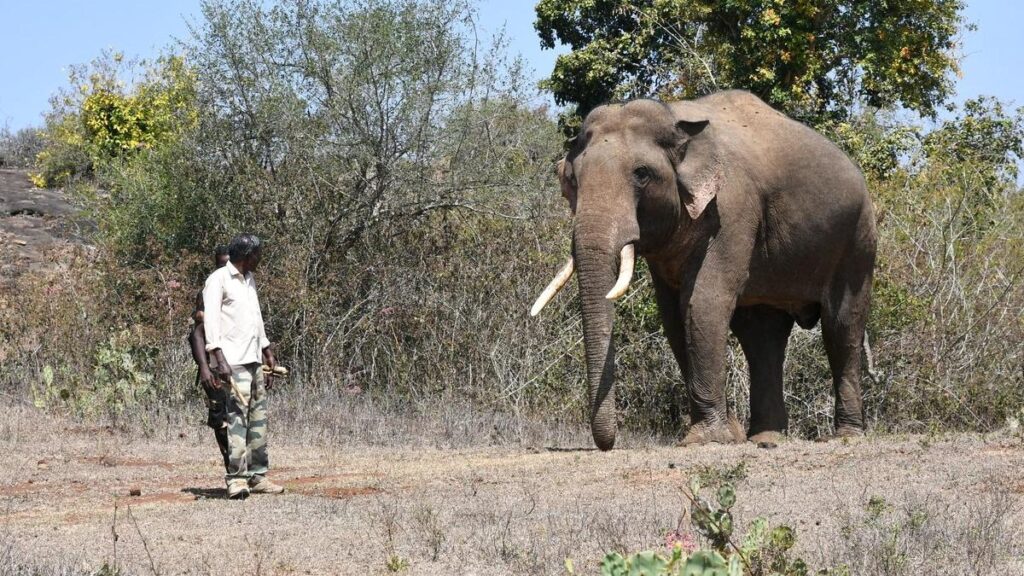
The fates of Rivaldo and Ronaldo, two tuskers named after iconic Brazilian footballers, inhabiting the notified Sigur Elephant Corridor in the Nilgiris, have become powerful case studies on the risks faced by wildlife caught in human-animal conflict. While Ronaldo met a tragic end due to negative human-elephant interactions, the story of Rivaldo offers a contrasting narrative: one that reminds us there is still hope for coexistence.
In 2021, Ronaldo died a slow and painful death after sustaining severe burn injuries when the owner of an illegal resort hurled a burning projectile at him as he approached the property in search of food. Rivaldo, on the other hand, continues to roam free today, following an intensive rewilding effort by the Tamil Nadu Forest Department aimed at steering him away from human settlements.
The measures taken to rewild Rivaldo, who would otherwise have had to live out his life in captivity, demonstrate how the department is at the forefront of cutting-edge conservation strategies in India, giving animals involved in human-wildlife conflict the greatest possible chance to live out their lives in the wild.
The process was extremely resource-intensive, one that involved forest staff guarding Rivaldo round the clock and preventing his entry into human habitations. The iconic Mudumalai tusker, who has shown no signs of aggression towards people, continues to regularly interact with other elephants in the area.
Similar success stories exist across the State, including that of the elephant Arikomban, who was relocated to the Kalakkad Mundanthurai Tiger Reserve (KMTR) after entering Tamil Nadu from neighbouring Kerala.
“Unless there is a long, documented history of a single elephant having repeated negative interactions with people, or there is an immediate risk of the animal endangering itself or humans, the State Forest Department’s de facto policy over the years has been to attempt to drive the animal back into surrounding forests or relocate it to other forest areas,” said a senior Forest Department official. The official added that while relocation is not a guaranteed solution to mitigating conflict, it offers elephants the best chance of finding an ecological niche that can discourage crop-raiding or entry into human settlements in search of food.


N. Mohanraj, a Nilgiris-based conservationist, said that elephants remain the species most likely to have negative interactions with human communities. “When we read news reports, we tend to believe that all elephants, or a majority of the elephant population, are involved in negative interactions with people. However, this is not the case,” he said.
Other conservationists noted that it is a small subset of elephants, primarily young males, that have learned to rely on high-calorie food sources available in human-dominated landscapes, either through crop-raiding or by entering settlements to target food storage facilities such as warehouses and ration shops. “If this small group of habitual crop-raiders, numbering no more than 70-80 individuals across the State, can be effectively discouraged from entering human settlements and prevented from becoming dependent on human food sources, conflict across the region can be largely mitigated,” said Mr. Mohanraj.
Habitat protection
The State government is also looking at more holistic conservation solutions to protect the habitats of Asian elephants in Tamil Nadu. A committee constituted by the government has identified 42 elephant corridors across the State. According to the committee’s report, around 3,000 elephants inhabit 20 of the 26 forest divisions. The report also noted negative interactions between humans and elephants in all divisions where elephants are present, with Gudalur, Coimbatore, Hosur, and Sathyamangalam accounting for much of the conflict.

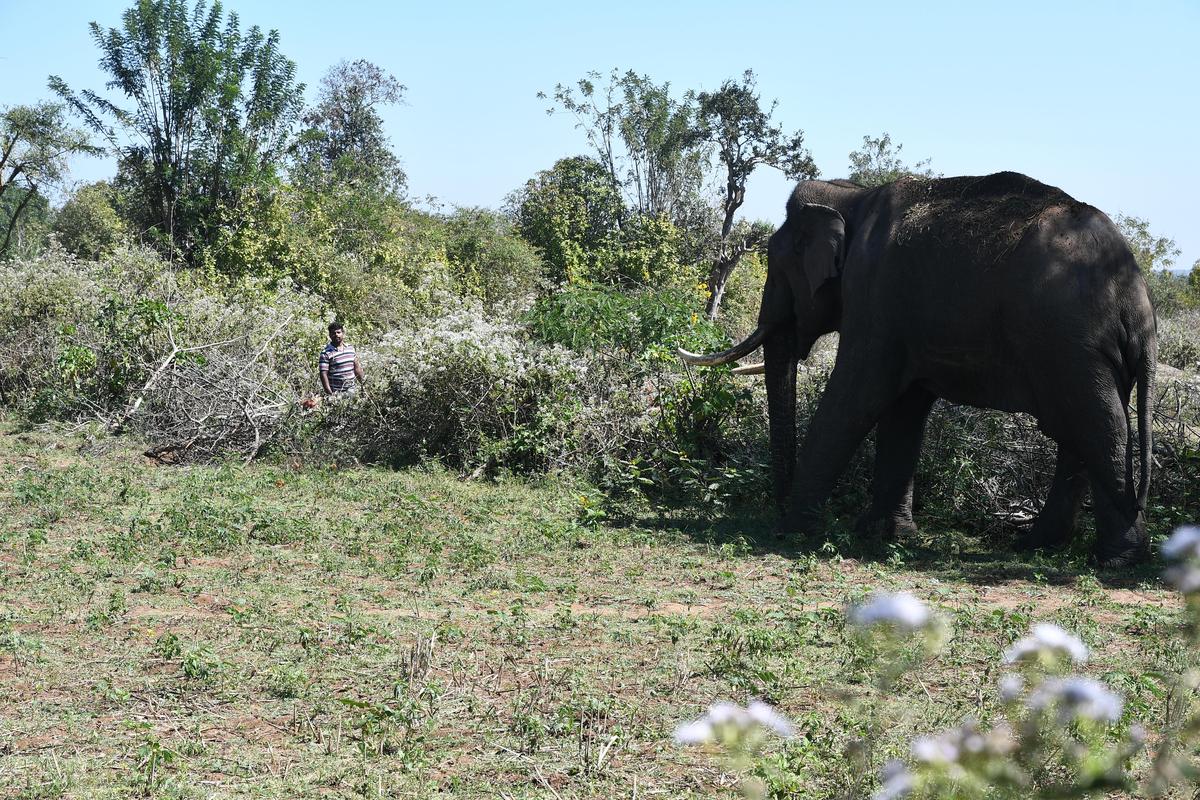
The famed elephant Ronaldo, in the buffer zone of Mudumalai tiger reserve on Sept 15, 2023.
| Photo Credit:
M. Sathyamoorthy
Some of these regions, such as Gudalur, need long-term solutions that focus on policy initiatives that can safeguard wildlife corridors, said conservationists.
One key region along the elephants’ traditional migratory route, through Gudalur, poses a significant challenge for the State government, they pointed out. The lands, known as ‘Section 17 lands’, were previously administered by the vassal kingdom of Nilambur Kovilagam. A significant portion, measuring around 80,000 hectares, is now classified under Section 17 of the Gudalur Janmam Estates (Abolition and Conversion into Ryotwari) Act. The status of these lands is yet to be settled by the settlement officer and, more often than not, they are located along crucial animal migratory pathways and in heavily forested areas.
Besides measures to tackle the thousands of recent illegal settlers seeking to take advantage of the land’s uncertain status, the government must also find an amicable solution that provides viable alternatives for the Sri Lankan repatriates brought to the area for tea cultivation, local conservationists said. They added that the major estates — occupying nearly half of the land classified under Section 17 and whose leases have long expired — should be evicted so that crucial animal pathways can be reclaimed by the Forest Department.
“With the Forest Department’s excellent recent record of preventing poaching and hunting across Tamil Nadu, animal populations, including Asian elephants and tigers, have rebounded significantly,” said N. Sadiq Ali, founder of Wildlife and Nature Conservation Trust. He added that with wildlife populations on the rise, it has become paramount to expand usable habitat for wildlife in the region.
“While populations are increasing, we are witnessing more animals venturing into towns and raiding crops. One reason could be that the current levels of usable habitat are simply insufficient, forcing animals to expand into previously unoccupied territories in search of food. One solution would be to reclaim the Section 17 lands from the major estates and allow them to be reforested,” said Mr. Sadiq. He added that any small growers settled on these lands who have a rightful claim should be compensated, either monetarily or with alternative land outside crucial animal corridors.
Problem predators
Apart from elephants, there have also been several negative interactions between people and carnivores, particularly in the Nilgiris. Over the past decade, the region has witnessed at least three “man-eater” tigers, and experts expect that such conflicts may increase further due to the rising tiger population across the landscape.
In 2023, following the capture of MDT-23, a tiger that had killed two people in Mudumalai, there were calls to set up a rescue and rehabilitation centre for ailing or injured tigers that might otherwise have negative interactions with humans. Experts say that a system to monitor “cattle-lifters” — typically older tigers that have lost their hunting ability and rely on domestic cattle — will be necessary to pre-emptively capture individuals that could potentially become “man-eaters”, helping prevent future human-wildlife conflicts in the region.
In the past two years, several tigers have been poisoned in the region after killing cattle or straying too close to human habitations in the Gudalur and Nilgiris forest divisions, experts noted. They said these incidents underscore the urgent need to develop strategies for managing species prone to negative interactions with humans, such as elephants, tigers, leopards, and sloth bears, in the future.
Technical solutions
To prevent elephant deaths from electrocution, the Forest Department has begun cracking down on farmers and residents using illegal electrical fences to protect their property. Measures have also been taken to deter elephants from entering towns such as Gudalur in the Nilgiris in search of food, including the installation of hanging electrical fences along forest boundaries.
There have also been recent efforts to harness technology and artificial intelligence (AI) in conflict-prone regions to mitigate challenges faced by both wildlife and human communities.
In the Madukkarai range of Coimbatore, where elephant deaths had become common due to collisions with trains, an AI-based early warning system has been installed to alert locomotive operators when elephants are crossing the tracks. This initiative has successfully reduced elephant fatalities along railway lines and is now serving as a model for other States across India facing similar challenges, officials said.

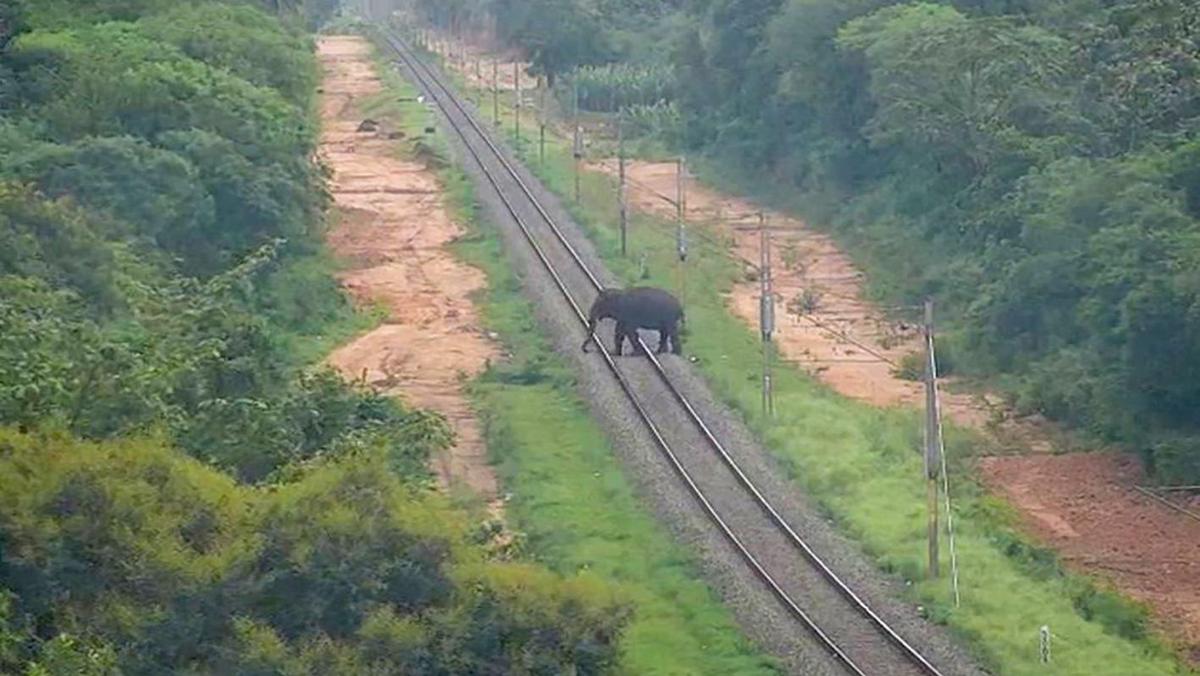
An elephant crossing railway track, captured by the AI-based early warning system in Madukkarai forest range of the Coimbatore Foerst Division on August 11, 2025.
| Photo Credit:
Special Arrangement
Similarly, in the Gudalur forest division of the Nilgiris, AI-based systems are being installed at 90 “conflict points” across the division. These points were identified as areas with a high incidence of human-animal interactions, often due to settlements located close to elephant habitats or along migratory pathways, officials said.
Forest Department officials said that the AI cameras — an upgraded version of the early warning system already functional in the division — would provide a less intrusive way to monitor and manage elephant movements. They noted that traditional barriers, such as solar fences and elephant trenches used in previous years and in other divisions, could disrupt elephants’ traditional migratory pathways and potentially increase human-elephant conflict. By harnessing new technologies, the Forest Department hopes to reduce negative interactions between humans and elephants while also protecting their habitats and corridors.
The AI cameras are to be installed at 90 conflict points across the division, where elephants are known to move from forests into human habitations. The cameras will also be fitted with thermal sensors to detect elephants straying too close to settlements, sending alerts to both local residents and the Forest Department’s Command and Control Centre, which is to be established at Gene Pool and Nadugani.

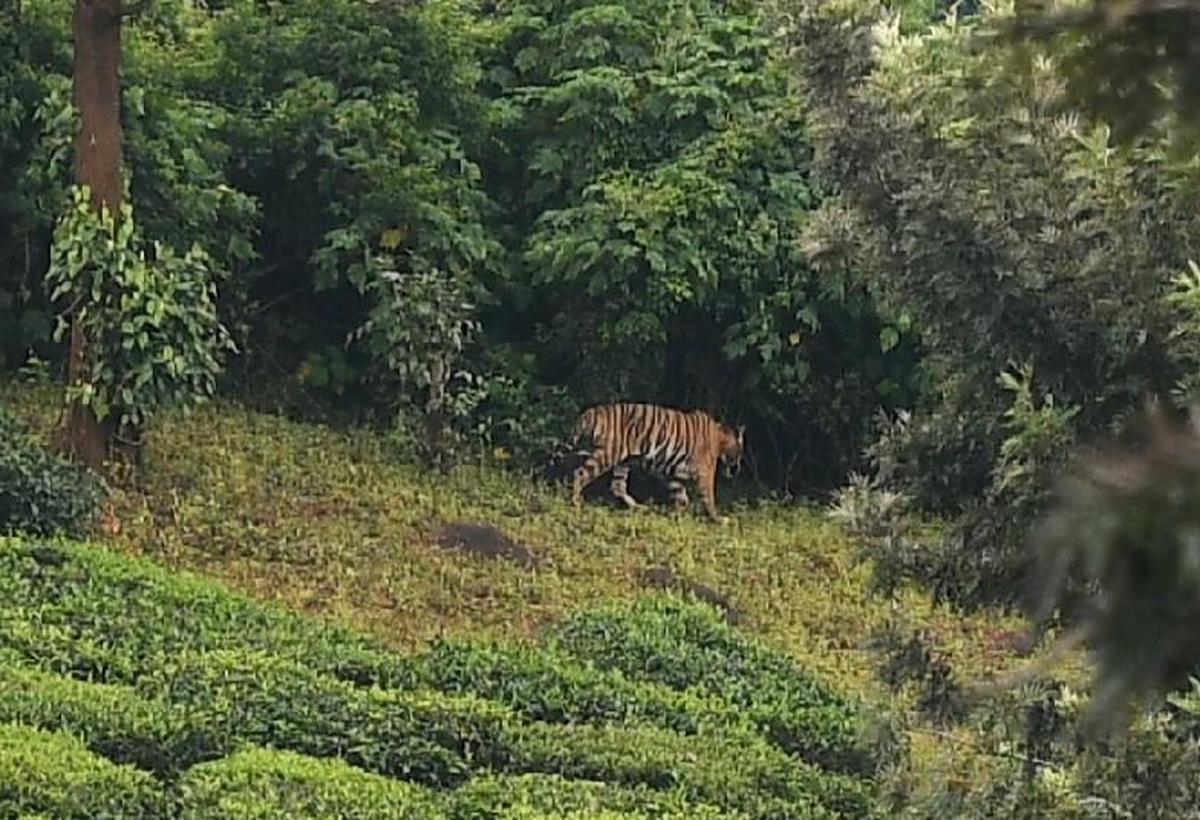
A tiger (called MDT 23), declared problematic by the DFO, was spotted at May Field estate near Gudalur during search operations to capture it in 2021.
| Photo Credit:
M. Sathyamoorthy
In the Nilgiris, Forest Department teams carry out daily monitoring of elephant herds near human settlements. They alert local communities to stay indoors when herds are nearby and simultaneously conduct operations to drive stray lone males and herds back into reserve forests.
Kumki elephants (highly trained, domesticated Asian elephants), stationed at camps in Theppakadu and Anaimalai, are also routinely deployed across the State to drive away problem elephants or assist in capturing and relocating animals from conflict areas.
In another high human-animal interface region, the Hasanur Forest Division in Sathyamangalam Tiger Reserve has proposed digging elephant-proof trenches (EPTs) spanning over 35 km in Talavadi. The trenches are expected to reduce human-elephant interactions in more than 20 villages across four forest ranges: Hasanur, Talavadi, Jerahalli, and Germalam.
Meanwhile, in both Coimbatore and the Nilgiris, efforts have been made to protect ration shops from elephant raids. In Anaimalai Tiger Reserve, container-style ration shops, sponsored by WWF-India, are being piloted to make it harder for elephants to break in. Similarly, a few shops in Mudumalai Tiger Reserve have been remodelled with a three-tier security system, including a hanging electrical fence, a steel cage, and narrow stairs leading into the shops, all designed to discourage elephants from entering in search of food.
Indigenous know-how
The Forest Department’s collaboration with indigenous communities to tame and train captured wild elephants has also proven to be an invaluable tool in managing human-animal conflict, said a senior official. “Generations of indigenous communities, experienced in capturing and training wild elephants, combined with modern techniques, have made most elephant capture and relocation operations in the State highly successful,” the official added.
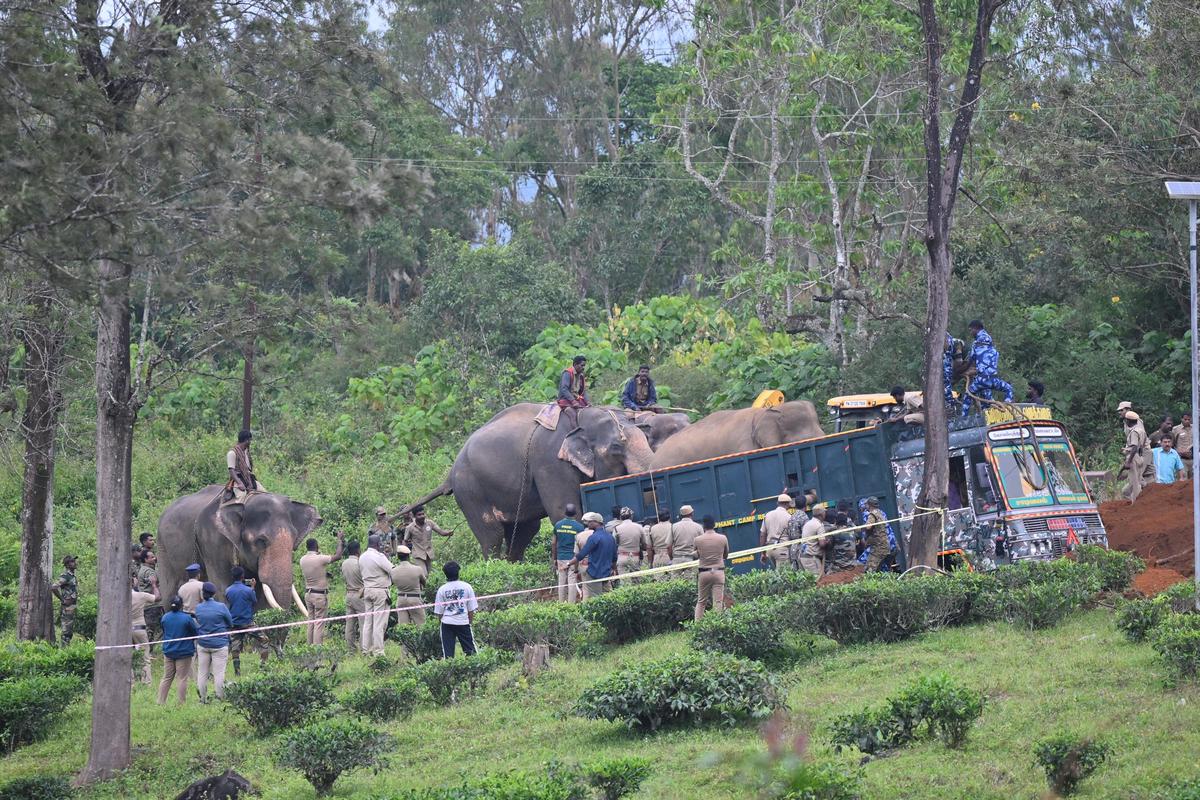
The problematic wild elephant been loaded on to a lorry at Yellamalai in September 2025.
| Photo Credit:
M. Sathyamoorthy
“When you compare our operations with those in other States in India, complications, such as animals being accidentally injured or killed, have been practically zero over the past few years,” he added.
“All our operations are meticulously planned to ensure minimal stress to the animals while also addressing human concerns for community safety. Such operations have resulted in almost no retaliatory actions against elephants. Those animals that do die from conflict are often accidental victims of electrocution,” the official added.

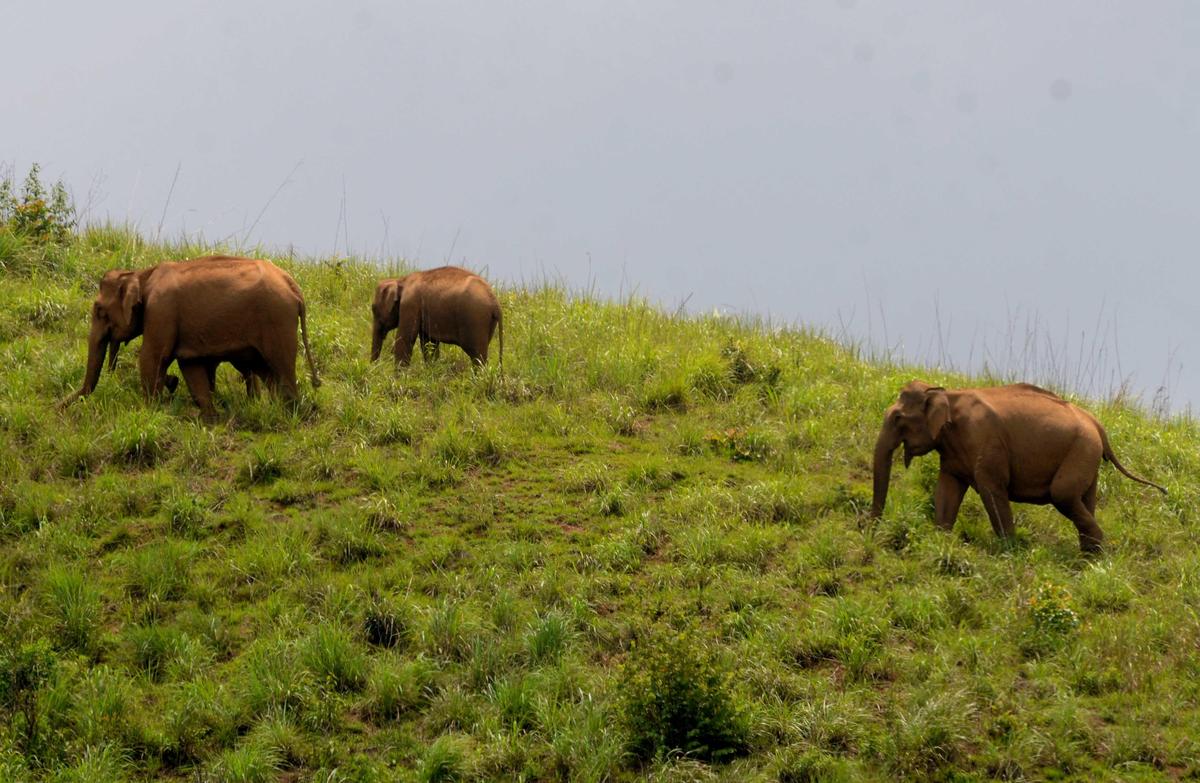
A herd of elephants grazing in the grasslands of Tantea estate near Gudalur.
| Photo Credit:
M. Sathyamoorthy
Priya Davidar, a conservation biologist who lived in Mudumalai and knew Ronaldo, the elephant that died from burn injuries in 2021, reflected on the animal in her essay titled Requiem for Ronaldo: “We need Ronaldos also to test our levels of tolerance and ability to coexist with other forms of life. Otherwise, we’ll be leaving a dead planet as a legacy to the future generations — if at all viable for them as well. Tribal people in this region are very often (or were) tolerant of wildlife such as elephants, whom they consider have a right to exist. Unfortunately, this is not shared by others who have settled here in the buffer zone, who often campaign for wildlife to be removed from their premises.”
Speaking to The Hindu, Ms. Davidar said that Ronaldo’s life exemplified the precarious existence of animals living in high human-animal interface areas. “For many animals, it is only a matter of time until their luck runs out and they fall victim to either human retaliation or other anthropogenic factors,” she added. She welcomed the Forest Department’s efforts to mitigate human-animal conflict across the State, noting that these measures must succeed in securing the future not only of the Asian elephant but of other wildlife as well.
This article is part of The Hindu e-book. Tamil Nadu’s progress: economic growth through social equality