
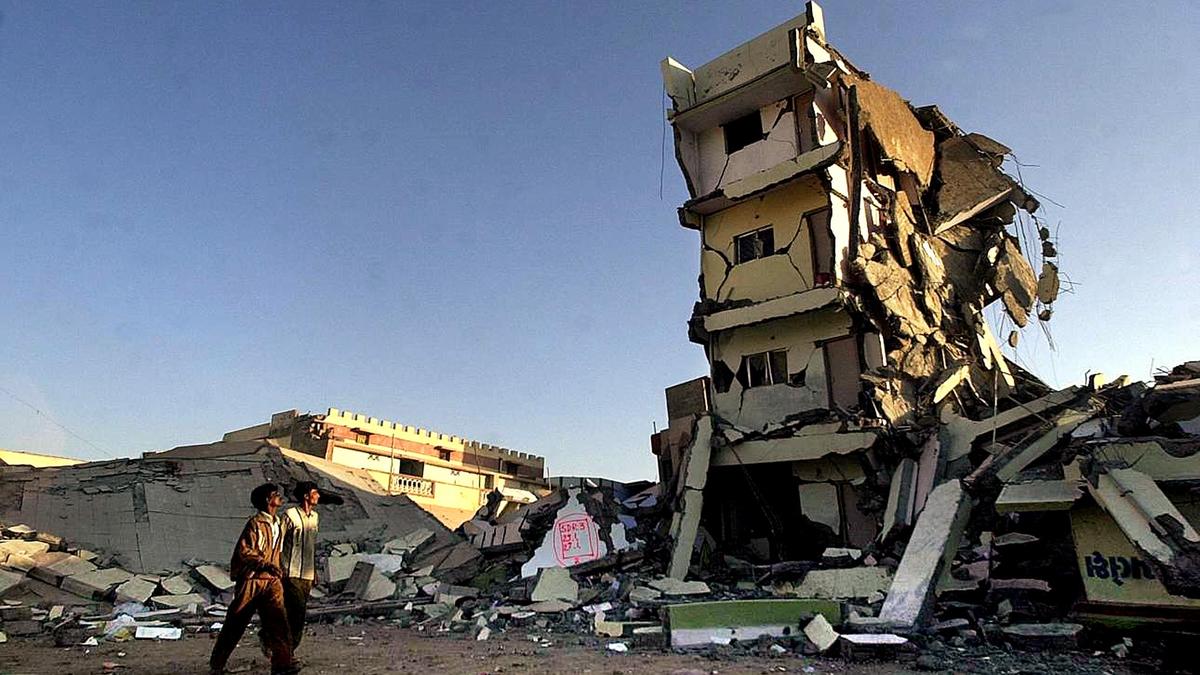
Are the risks to structures in the Himalayas and north-eastern states from earthquakes overestimated? Scientists, structural engineers, representatives from several government ministries are expected to deliberate and report back to the Cabinet Secretariat in the coming weeks.
This follows a ‘withdrawal’ earlier this month by the Bureau of Indian Standards (BIS) of a set of updated criteria that construction projects ought to incorporate to guard against collapse when impacted by earthquakes.
The withdrawal was prompted – as The Hindu reported on March 7 – by an order from Cabinet Secretariat, that said the new standards “materially affected … ongoing and future infrastructure projects including metro rail projects,” and that a “holistic and comprehensive review of the revised IS 1893 be conducted, taking into account the perspectives of all stake holders.”
However, a decade’s worth of studies – commissioned and approved by the government – and involving scientists from the most reputed institutions in India with expertise in geology, seismology, geotechnical engineering and structural engineering, are unambiguous: the potential damage to all structures, whether residential buildings, bridges, industrial structures or water tanks, dams, power plants in the Himalayan States are far higher than the current risk assessments, which in turn feed into existing building codes across the country.

Four zones
The IS 1893 ‘Criteria for Earthquake Resistant Design of Structures’ is a five-part document published by the Bureau of Indian Standards (BIS) that provides the mandatory guidelines that engineers and architects must follow to ensure buildings and infrastructure can survive seismic activity.
India’s seismic zoning maps delineate the country into four zones (Zone 2II, III 3, IV4 and V5). Zone 2 II is the calmest part of India’s seismic landscape. The ground beneath you might shake noticeably during your lifetime, but the forces involved are relatively modest. The 2016 version of India’s seismic zoning map – the one that was to have been superseded by the now withdrawn 2025 avatar – assigns a design acceleration of 0.10 g in Zone II, meaning engineers expect the sideways force on a building to be no more than about 10% of the downward pull of gravity during the strongest plausible earthquake in the area.
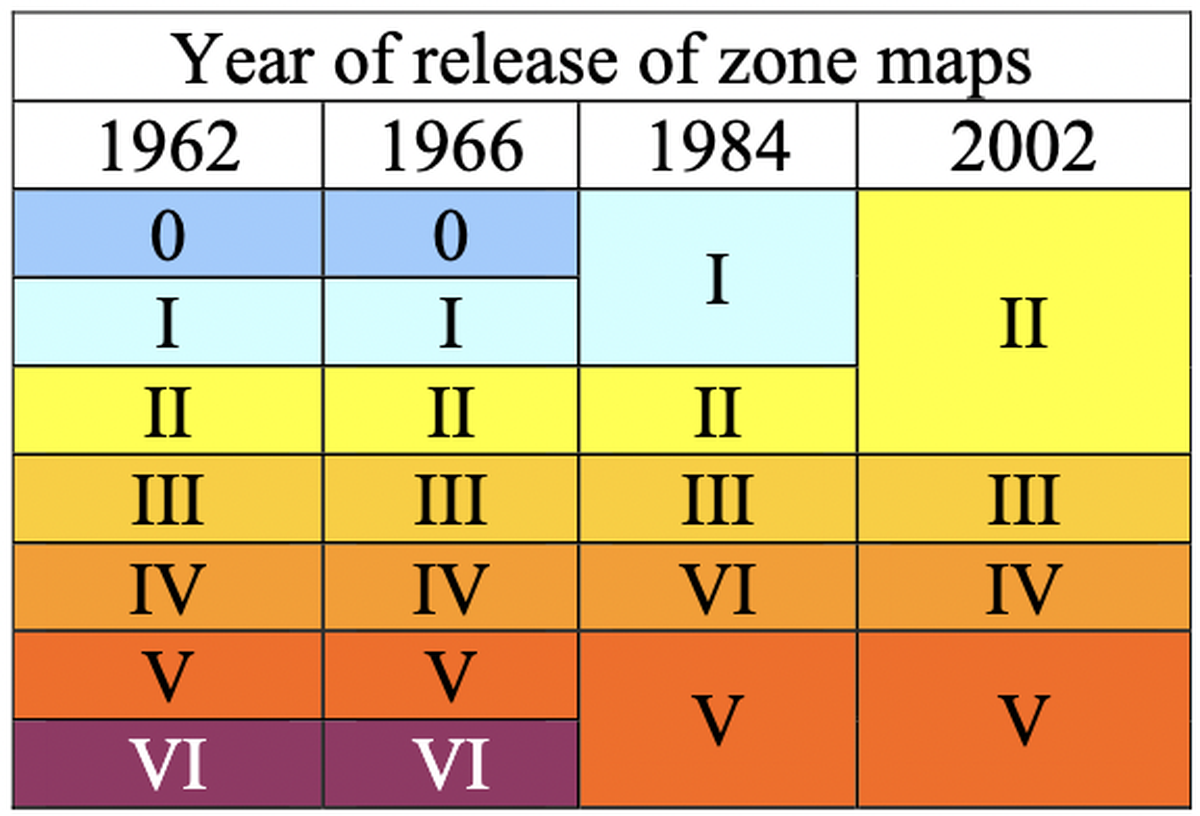
Earthquake zones of India were reduced with each subsequent revision, owing to an increased perception of earthquake threat.
| Photo Credit:
Journal of Earth System Science, Vol. 133, article no. 158, (2024)
Zone V is a fundamentally different proposition. The design acceleration is at least 0.36 g, or three and half times higher than Zone II. At those forces, the ground is lurching sideways with a force equal to one-third of gravity. Unsecured furniture topples, people cannot stand without holding on to something, and buildings experience forces that can buckle steel columns, shatter concrete, and cause floors to pancake onto one another if not designed suitably. This is the zone assigned to areas along the Himalayan front and parts of northeast India — regions sitting directly on or adjacent to one of the most active tectonic plate boundaries on Earth, where the Indian plate is driving into the Eurasian plate and where magnitude 8 earthquakes have occurred within living memory. These proportions – 10%, 36% – are usually expressed as 0.10g and 0.36g and called ‘peak ground acceleration’ (PGA) values in seismic zoning language.
At a distance of, say, 20 km from the fault — close enough to be in the zone of strong shaking but not directly on the rupture — a magnitude 6 earthquake on rock might produce PGA values in the range of 0.15-0.30 g used. A magnitude 7 earthquake, which releases about 32-times more energy, at the same distance would typically produce PGA values in the range of 0.40 to 0.80 g. At very close distances, say 10 km, a magnitude 7 can produce PGA values exceeding 1.0g. So, the ratio is roughly a factor of 2.5 to 3.5 in PGA for a one-unit increase in magnitude at the same distance.
Too conservative
Prior to the BIS withdrawal was a 2024 paper in the peer-reviewed Indian Journal of Earth System Sciences that radically upended how India since the 1960s has accounted for the risk from earthquakes in building design. It proposed a new method to estimate earthquake hazard risk and making it consonant with how the rest of world computes it and, inevitably – and ultimately controversially – increased the PGA values that underlie current building codes.
This wasn’t a purely academic study: it was the outcome of a project commissioned in 2019 by the National Disaster Management Authority (NDMA), from IIT-Madras and BIS, to bring India up to speed with the rest of the world and create a ‘probabilistic risk hazard assessment map’ for India. This was preceded by two other projects, one from 2007-11 (funded by the NDMA) and another from 2013-17 funded by the Department of Science and Technology, both all of which were intended to move India’s earthquake hazard assessment towards a probabilistic framework.

The NDMA had accepted this study, following which its outcomes were published by the BIS in IS 1893 (Part 1) as a 2025 update of India’s design earthquake hazard and zoning map – which was then withdrawn.
The authors of the paper comprise scientists from some of India’s most reputable institutions, including the IITs of Bombay and Madras, the Atomic Energy Regulatory Board, and the Geological Survey of India.
“These PGA values are not derived based on any quantitative earthquake hazard assessment and are abysmally low, especially for the higher earthquake zones. For example, the regions of the Himalayan plate boundary and northeast India with the potential to produce earthquakes exceeding magnitude 8.0 are covered by earthquake zones IV and V with design PGA values of 0.24 and 0.36 g, respectively, whereas the 1897 Great Shillong Plateau earthquake in northeast India is reported to have resulted in PGA values more than 1.0 g,” the report in their study.
They argue that acceleration values in India are too conservative by international standards.
“The design accelerations in similar areas worldwide are taken to be two times (or more) compared to that in the existing zone map of India. Therefore, there is a need to revise India’s current earthquake-resistant design code on the basis of an adept quantitative technique such as hazard analysis,” said a multi-author study led by researchers from IIT-Madras but which included several other authors from other institutes and organisations.

Government House in Shillong before and after the 1897 earthquake.
| Photo Credit:
Public domain
Barely a century old
In previous assessments, a region was assigned a Zone IV or Zone V classification only retrospectively, that is, after it had experienced a significant earthquake. The surrounding areas, which often were as susceptible, were assumed to be at lower risk even though evidence had built up over decades that they were often regions with pent up strain that hadn’t been released.
The current framework also didn’t account for local soil conditions, which could amplify the waves emanating from the centre increasing the forces a building was subject to. It also overlooks a network of 168 monitoring stations, most of them in the Himalaya, that relay data on even small earthquakes of magnitudes of 2 and 3 and their associated energy waves from India’s neighbourhood, including Afghanistan and Xinjiang.
“The earth is a dynamic system. Every 50 years or so, PGA values change by about 10%. Age affects the human body, and similarly the earth,” said O.P. Mishra, former director, National Centre for Seismology (NCS), India’s official repository of earthquake data. “In a probabilistic assessment you account for a variety of factors that might influence shaking and that serves as a reference point for builders… India has stated its commitment to be disaster resilient by 2047.”
Dr. Mishra was part of a BIS committee to revise the code.

The historical record for great earthquakes in India is extremely short relative to their recurrence intervals. The authors cite four great Himalayan earthquakes since the late 1800s — Shillong in 1897, Kangra in 1905, Bihar-Nepal in 1934, and Assam-Tibet in 1950. But these four events occurred on different segments of the plate boundary. Any individual segment might experience a great earthquake only once every 250 to 500 years, according to the authors’ estimates. India’s instrumental seismic record is barely a century old, and the historical record, while longer, is patchy and incomplete. A 500-year recurrence event has a reasonable probability of occurring during a building’s 50-year design life (roughly 10%), but may not have occurred at all during the available observation period for a given fault segment.
The traditional approach has no mechanism for accounting for this.
‘Costs will go up’
Over 79% of India’s population lives on approximately 57% of its land, under the threat of moderate to severe earthquake hazard. By 2046, the urban population is projected to exceed the rural population, the study notes underlining the necessity for updated acceleration values.
The new map assigns PGA values of 0.15 g, 0.3025 g, 0.4535 g, 0.605 g, and 0.75 g for zones II through VI, nearly doubling the hazard estimates in the higher zones and bringing them closer to what comparable regions internationally are designed for. It’s these values that have likely rattled agencies such as the Delhi Metro Rail Corporation and the National Dam Safety Authority.
The new map also introduces a fifth zone, Zone VI, for regions where PGA estimates exceed 0.6 g. This captures the most seismically active areas – parts of the Himalayan plate boundary and northeast India – that were previously all lumped together in Zone V at an inadequate 0.36g. It also draws on a much richer dataset and methodology than any predecessor: an earthquake catalogue of 69,519 events spanning from 2600 BC to December 2019.
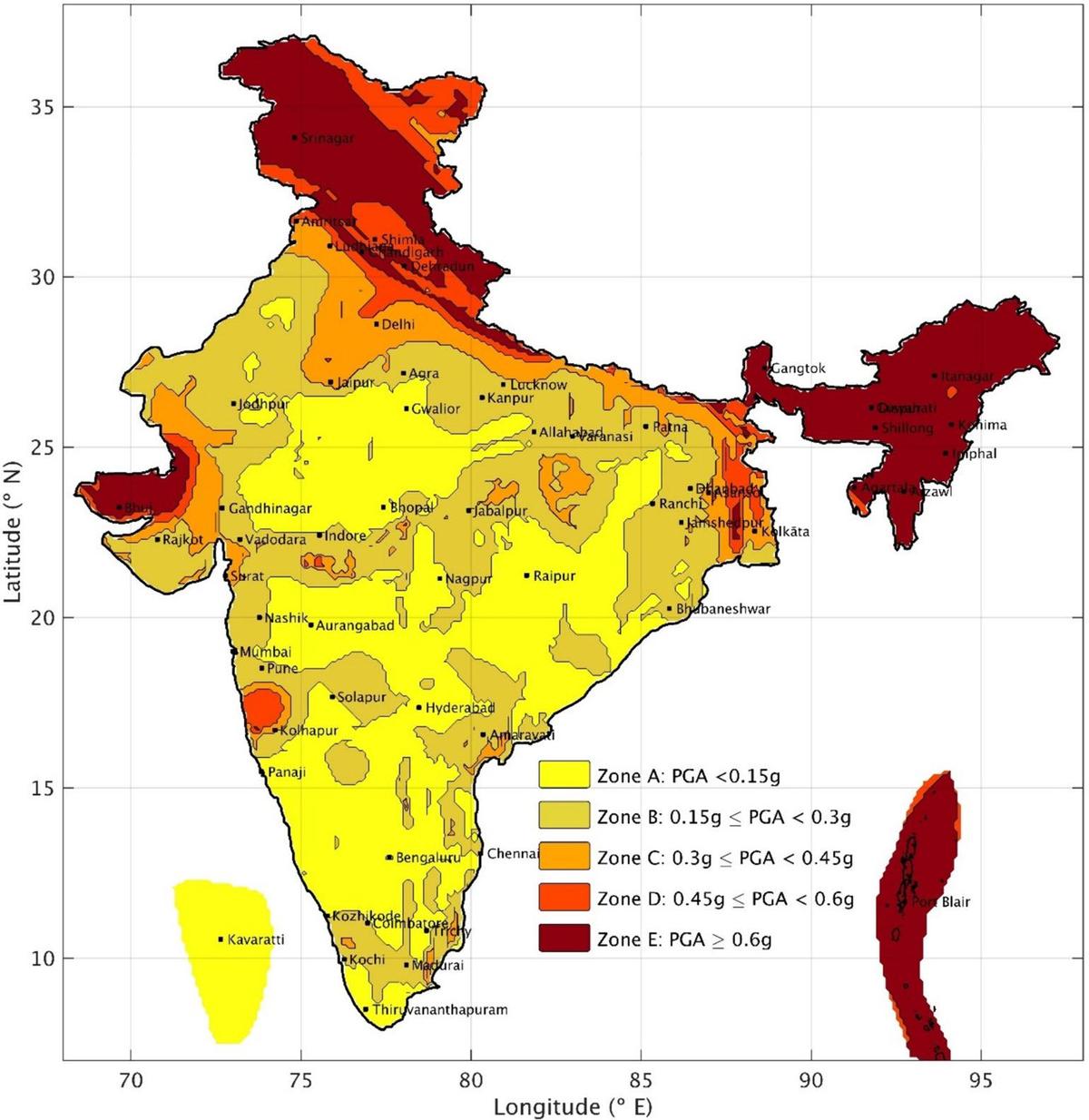
The raw zone map of India.
| Photo Credit:
Journal of Earth System Science, Vol. 133, article no. 158, (2024)
“The assessments are scientific. However a figure like 0.75g represents a worst worst-case scenario. The practice is usually to halve the PGA value as a representative of what is likely and then, depending on the criticality of the structure, plan the structure,” said a government department official who declined to be on record.
“Recent evidence shows that 95% of those who die in earthquakes are those who live in 1-3 storey houses that are inadequately designed,” said another scientist who was involved in the exercise but also declined to be identified. “The 0.75 factor is also a lower number. While there are consultations in the offing on what design adjustments may be made, it is quite clear that the risks we have now computed are closer to reality.” Pakistan and Nepal, this person added, use values close to 0.75 g, and as well as the United States and Japan routinely calculated values of 1 g or more, depending on the region at stake.
One official of the NDMA who was privy to developments around the zoning map said that the scientific assessment results were a result of “too pure science.” He said that while the NDMA had indeed considered the report, the difficulty that cropped up was that recommended acceleration values “were too high” and would significantly strain government public spending.
“On one hand we have the situation that a large proportion do not follow even the existing (2016) codes. Then with these stringent numbers, steel, cement costs will go up manifold – where there is money to build four schools or clinics in a village, only one will be made. Finally, it doesn’t give builders the freedom to do their own assessments and compute the PGA risks. This ended up being too theoretical an exercise.”
The NDMA didn’t respond to requests for an official comment.
jacob.koshy@thehindu.co.in