

You are getting a brighter and tougher display with unique features, a far more efficient and powerful Snapdragon chipset (globally), improved thermals with a new vapor chamber, faster wired and wireless charging speeds, and a camera system that has shifted toward a more practical zoom and natural image processing.
Galaxy S26 Ultra vs Galaxy S22 Ultra differences:
| Galaxy S26 Ultra | Galaxy S22 Ultra |
|---|---|
| 6.9-inch QHD+ Dynamic AMOLED 2X, 1–120Hz | 6.8-inch QHD+ OLED, 1–120Hz |
| Up to 2,600 nits peak brightness | Peaks at around ~1,750 nits |
| Gorilla Glass Armor 2 with anti-reflection | Gorilla Glass Victus+ |
| Privacy Display modes (pixel-level side-angle protection) | No privacy viewing mode |
| Snapdragon 8 Elite Gen 5 for Galaxy (3 nm) in all regions | Snapdragon 8 Gen 1 in select regions, Exynos 2200 elsewhere |
| Improved thermals with a new vapor chamber | Older thermal system, more throttling under load |
| 200 MP main with f/1.4 aperture | 108 MP main with f/1.8 aperture |
| 50 MP ultrawide and modern 5x telephoto system | 12 MP ultrawide and dedicated 10x periscope |
| Super Fast Charging 3.0 (60W), up to ~75% in about 30 minutes | Slower wired charging experience |
| Super Fast Wireless Charging (25W tier) plus Wireless PowerShare | 15W wireless plus Wireless PowerShare |
| APV pro video format support (up to 8K at 30 fps) | No APV support |
| Android 16 and One UI 8 with seven years of support | Launched with Android 12, nearing final OS updates |
| Armor Aluminum 2 frame | Armor Aluminum frame |
Table of Contents:
Design and Size
From Note-inspired bulk to a slimmer Ultra
The Galaxy S26 Ultra still has that Note DNA, including the built-in S Pen, but it trims the profile in a way that should be immediately obvious if you are coming from an S22 Ultra. It drops to 7.9 mm thickness and 214 grams, compared to 8.9 mm and 229 grams for the S22 Ultra. That combination of a full millimeter shaved off and a meaningful weight reduction changes how the phone feels when you use it daily.
| Galaxy S26 Ultra | Galaxy S22 Ultra |
|---|---|
| Thickness 7.9 mm |
Thickness 8.9 mm |
| Dimensions 163.6 x 78.1 mm |
Dimensions 163.3 x 77.9 mm |
| Weight 214 grams |
Weight 229 grams |
Display Differences
The Galaxy S26 Ultra comes with a 6.9-inch QHD+ panel with peak brightness rated at 2,600 nits, which is a significant jump over the S22 Ultra’s roughly ~1,750 nits. Just as important, the S26 Ultra pairs that panel with Gorilla Glass Armor 2 and an anti-reflective coating, which helps keep the display readable outdoors by reducing glare instead of just brute-forcing it through brightness alone.
| Galaxy S26 Ultra | Galaxy S22 Ultra |
|---|---|
| Size 6.9″ |
Size 6.8″ |
| Brightness 3000 nits (peak) |
Brightness 1750 nits (peak) |
A new addition this year is Privacy Display. It is a pixel-level viewing protection mode with Standard and Maximum settings, designed to reduce side-angle visibility while keeping the screen clear head-on. In practice, this is meant to help with shoulder surfing in public spaces. Making it even better is the fact that you can customize when it activates, be it in a specific app or during a specific action like typing your PIN.
Performance and Software
A massive generational leap, plus better sustained performance
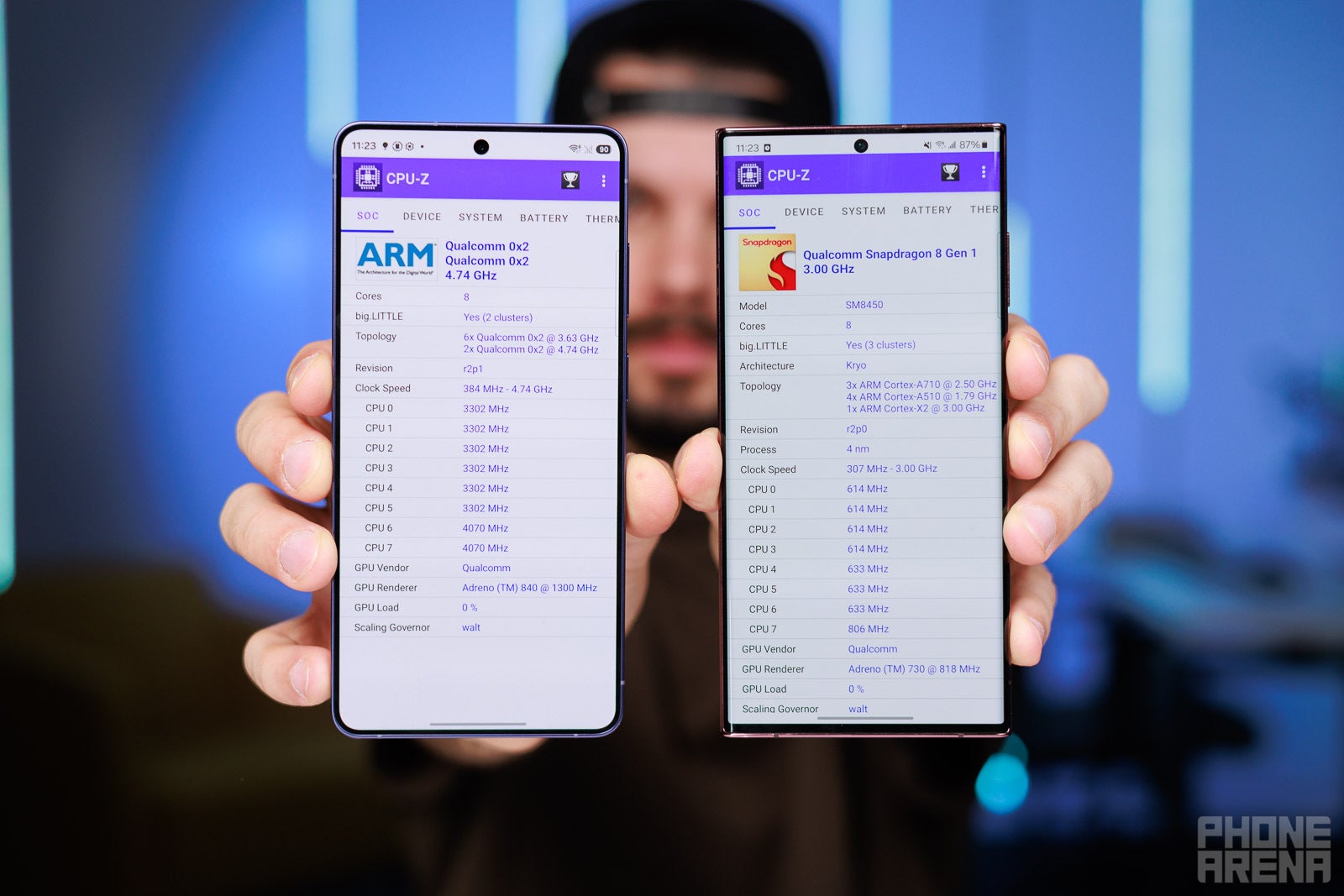
Four generations later, the S26 Ultra leaves the S22 Ultra’s heat and throttling era behind. | Image by PhoneArena
The Galaxy S22 Ultra launched with Snapdragon 8 Gen 1 in select regions and Exynos 2200 elsewhere. Both chips were known for running hot and throttling, which affected everything from using the camera, longer navigation sessions and, of course, gaming.
The Galaxy S26 Ultra runs the Snapdragon 8 Elite Gen 5 for Galaxy worldwide, built on a refined 3 nm process by Qualcomm. Samsung also backs the new chip with a redesigned thermal system, including a new vapor chamber to keep performance strong for longer before heat forces the phone to pull back.
| Galaxy S26 Ultra | Galaxy S22 Ultra |
|---|---|
| Chip Snapdragon 8 Elite Gen 5 |
Chip Snapdragon 8 Gen 1 / Exynos 2200 |
| Process 3nm |
Process 4nm |
| RAM, Storage 12/256GB 12/512GB 12/1TB 16/1TB LPDDR5X RAM |
RAM, Storage 8/128GB 12/256GB 12/512GB 12/1TB LPDDR5X RAM |
CPU Performance Benchmarks:
GPU Performance:
Camera
From the 108 MP era to a refined 200 MP main camera and better zoom
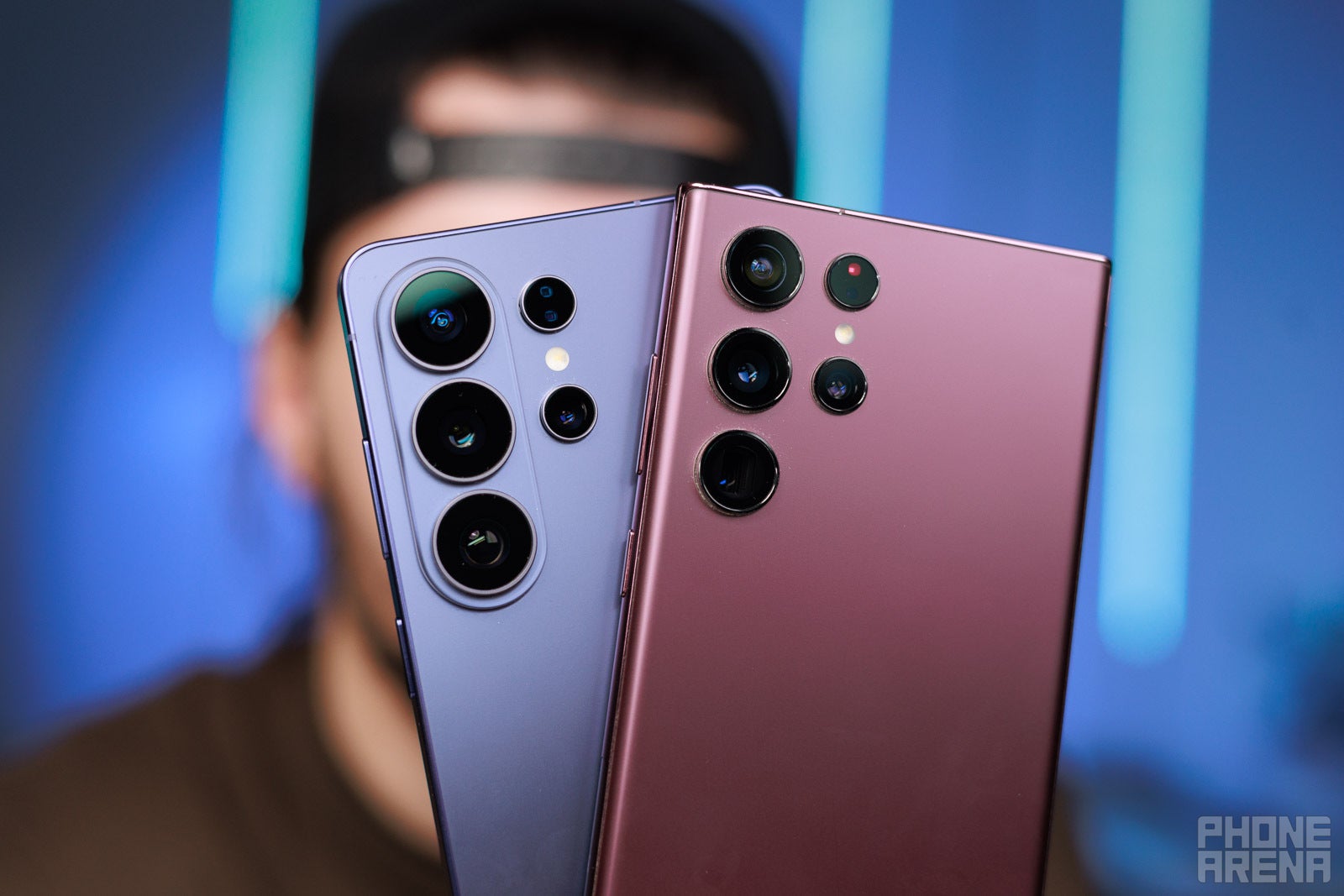
From a niche 10x trick to a smarter 200 MP system, the S26 Ultra makes zoom practical again. | Image by PhoneArena
The Galaxy S26 Ultra modernizes things with a main camera powered by a 200 MP sensor. This generation also upgrades things with a wider f/1.4 aperture, which should pull in more light and improve low-light detail and dynamic range. The ultrawide is the same 50 MP one introduced with last year’s model, which is sharper than the old 12 MP ultrawide on the S22 Ultra.
Samsung also continues the Ultra line’s shift toward a more practical telephoto setup. Instead of a dedicated 10x lens, the S26 Ultra uses a 50 MP 5x camera with a wider aperture. You can still achieve pretty good results when using 10x zoom thanks to Samsung’s image processing and the new image sensor powering that camera.
| Galaxy S26 Ultra | Galaxy S22 Ultra |
|---|---|
| Main 200 MP, f/1.4 aperture 25 mm 1/1.3″ sensor size |
Main 108 MP, f/1.8 24 mm 1/1.33″ sensor size |
| Ultrawide 50 MP, f/1.9 13 mm 1/2.5″ sensor size |
Ultrawide 12 MP, f/2.2 13 mm 1/2.55″ sensor size |
| 3x Telephoto 10 MP, f/2.4 3X zoom (67mm) 1/3.94″ sensor size |
3x telephoto 10 MP, f/2.4 3X zoom (70mm) 1/3.52″ sensor size |
| 5x telephoto 50 MP, f/2.8 5X zoom (111mm) 1/2.5″ sensor size |
10x telephoto 10 MP, f/4.9 10X zoom (230mm) 1/3.52″ sensor size |
Video has also received a major upgrade, and one of the most important additions is APV support. APV is Samsung’s pro-oriented video format designed to capture higher-quality footage with more data preserved for editing while giving you control over quality levels and file sizes. On the S26 Ultra, Samsung pairs this with higher-end video features like up to 8K at 30 fps, 4K 120fps, improved HDR handling, and more advanced stabilization processing than what the S22 Ultra can offer.
Battery Life and Charging
Same capacity, but a very different experience
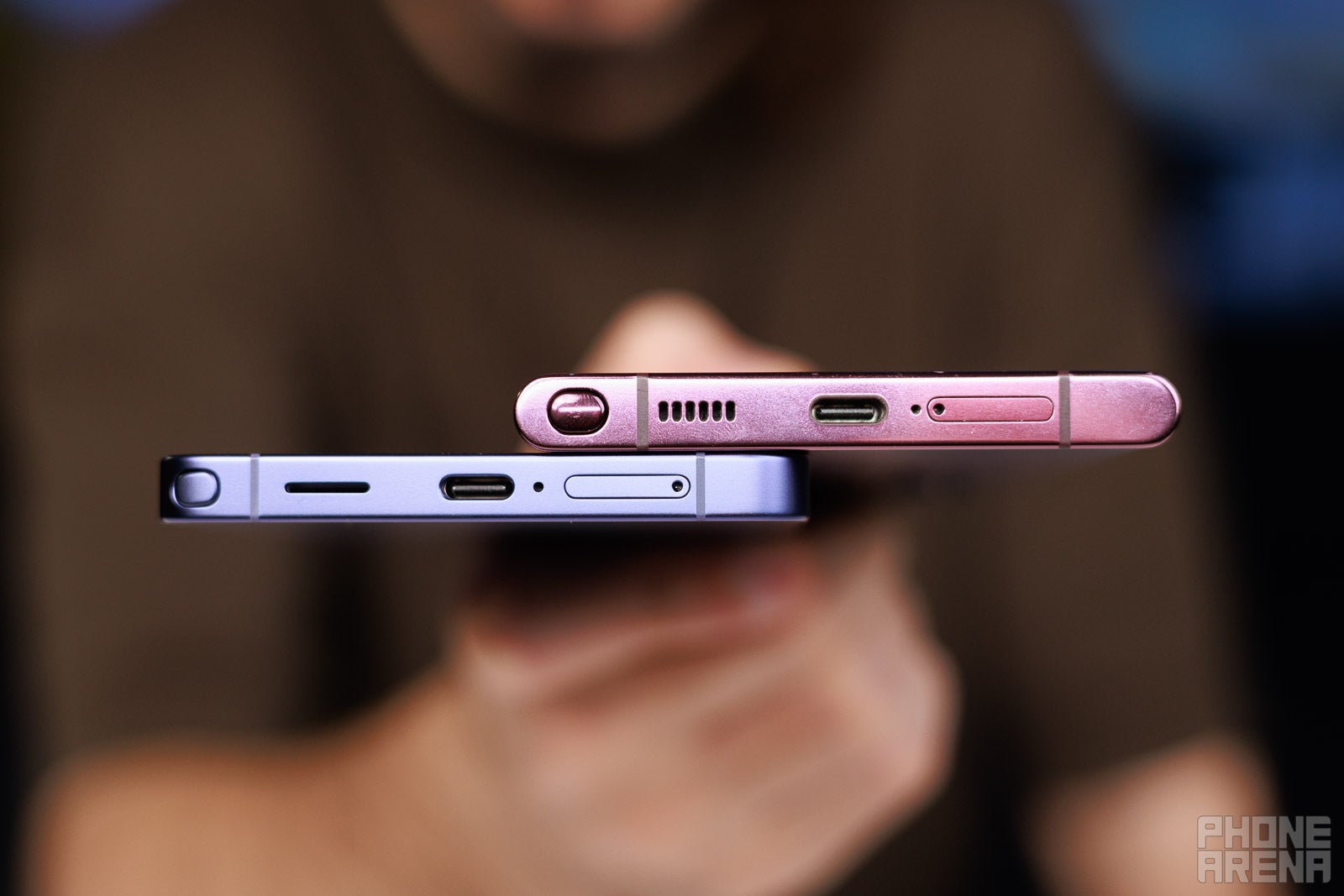
Same 5,000 mAh, but with completely different efficiency and much better charging. | Image by PhoneArena
The S22 Ultra’s chips were not known for their great efficiency, and many owners remember that generation as one with inconsistent battery life. The S26 Ultra benefits from a far more efficient 3 nm platform, plus better display efficiency and software optimization, so real-world endurance should be on a completely different level even at the same capacity.
Charging is also meaningfully improved. Samsung moves to Super Fast Charging 3.0 at 60W, and it also upgrades wireless charging to the 25W tier while keeping Wireless PowerShare.
| Galaxy S26 Ultra | Galaxy S22 Ultra |
|---|---|
| Battery size 5,000 mAh |
Battery size 5,000 mAh |
|
Charging speeds 25W wireless charging USB-C 3.2 |
Charging speeds 25W wired 15W wireless charging USB-C 3.2 |
Specs Comparison
|
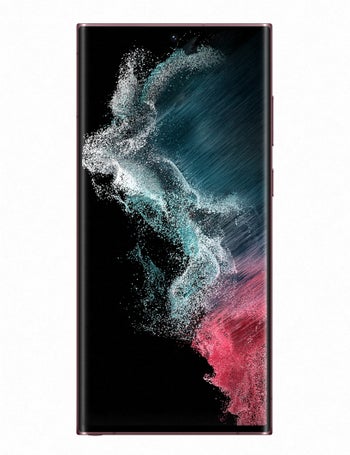
|
| Samsung Galaxy S26 Ultra | Samsung Galaxy S22 Ultra |
| Dimensions | |
|---|---|
| 163.6 x 78.1 x 7.9 mm (~10 mm with camera bump) | 163.3 x 77.9 x 8.9 mm (~10.50 mm with camera bump) |
| Weight | |
| 214.0 g | 229.0 g |
| Size | |
|---|---|
| 6.9-inch | 6.8-inch |
| Type | |
| Dynamic AMOLED, 120Hz | Dynamic AMOLED, 120Hz |
| System chip | |
|---|---|
| Snapdragon 8 Elite Gen 5 SM8850-AC (3 nm) | Snapdragon 8 Gen 1 SM8450 (4 nm) International version – Samsung Exynos 2200 (4 nm) |
| Memory | |
| 12GB (LPDDR5X)/256GB (UFS 4.0) 12GB/512GB 16GB/1024GB |
8GB (LPDDR5)/128GB (UFS 3.1) 12GB/256GB 12GB/512GB 12GB/1024GB |
| Type | |
|---|---|
| 5000 mAh | 5000 mAh |
| Charge speed | |
| Wired: 45.0W Wireless: 15.0W |
Wired: 45.0W Wireless: 15.0W |
Samsung Galaxy S26 Ultra vs Samsung Galaxy S22 Ultra specs comparison
or compare them to other phones using our
Phone Comparison tool
Summary
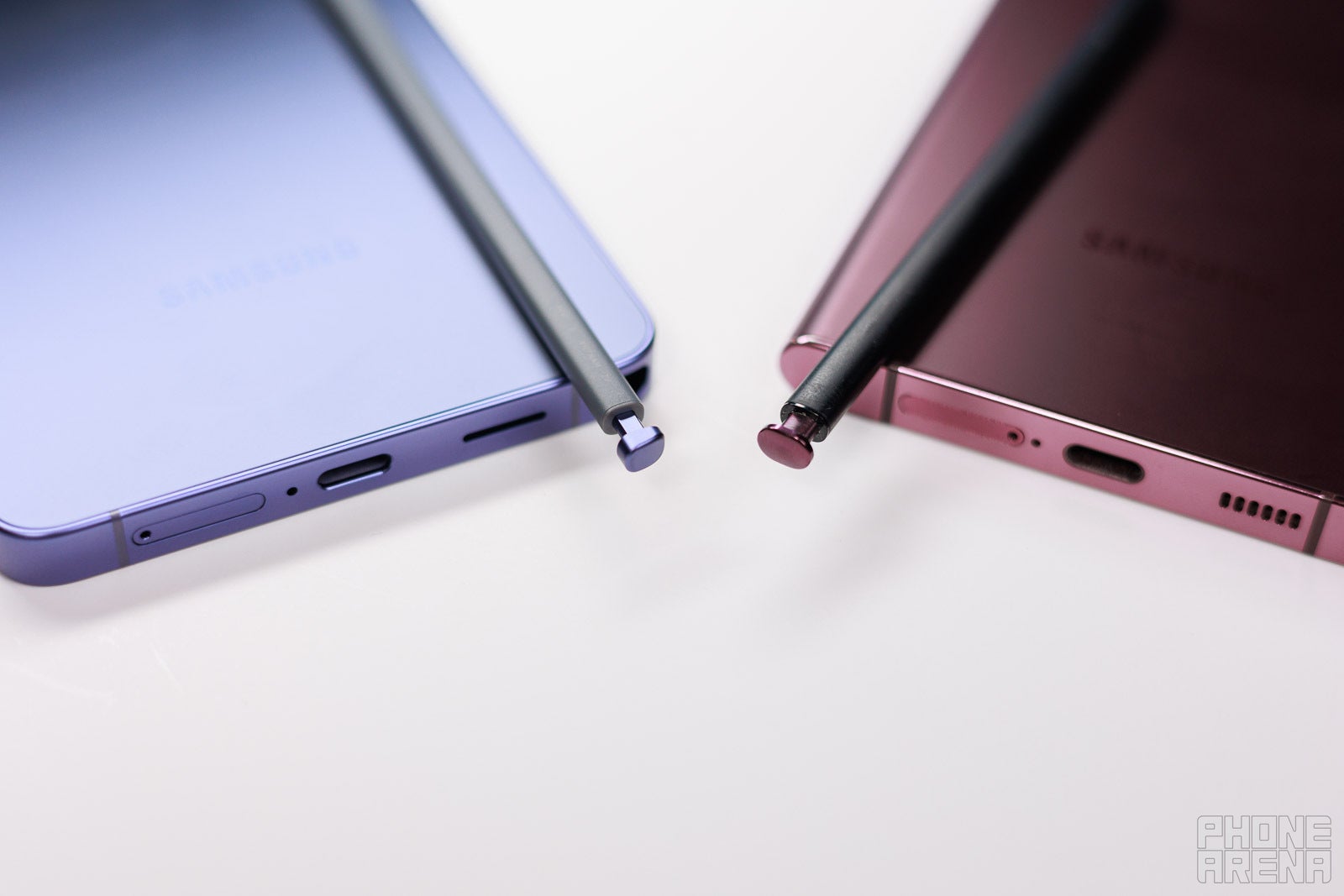
From S22 Ultra to S26 Ultra, this is not an upgrade. It is a complete reset. | Image by PhoneArena
You get a slimmer and lighter design, a brighter and more usable display with Gorilla Glass Armor 2 and anti-reflection, and a Privacy Display mode. You also get a massive performance leap with the Snapdragon 8 Elite Gen 5 for Galaxy, backed by a new vapor chamber and updated thermal materials for stronger sustained performance.
The camera system shifts from the older 108 MP and 10x era into a modern 200 MP setup with f/1.4 optics, a 50 MP ultrawide, and a more practical 50 MP 5x telephoto designed to cover common zoom ranges while still delivering “optical-quality” longer zoom results.