
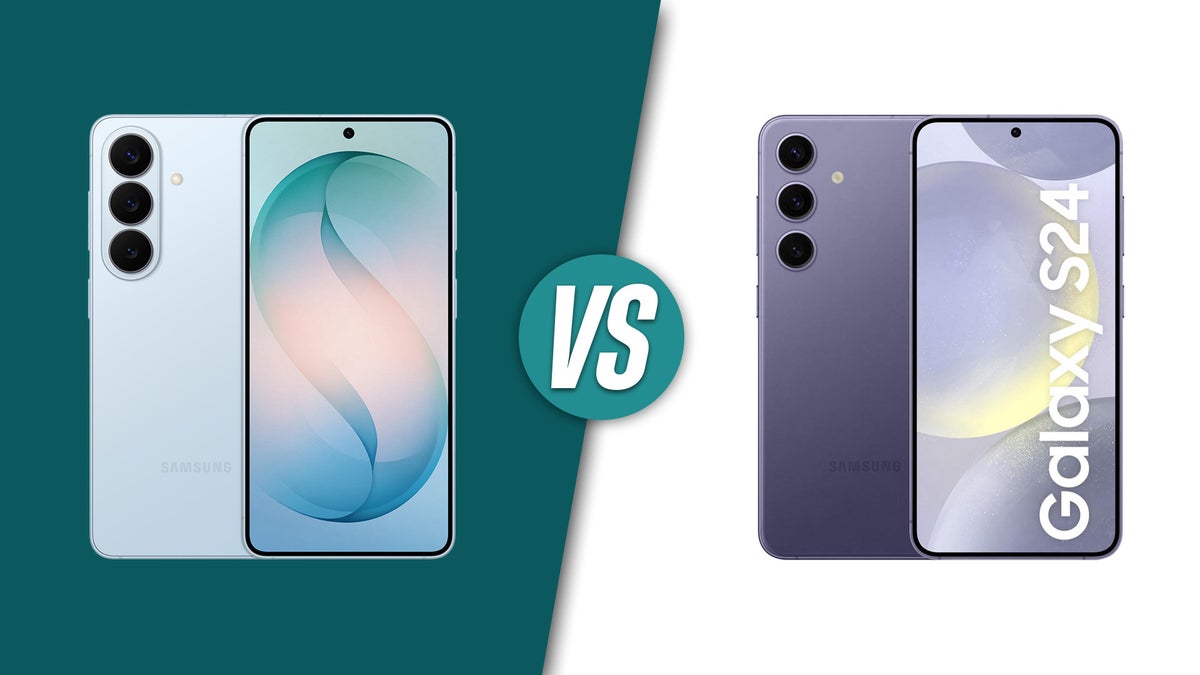
| Galaxy S26 | Galaxy S24 |
|---|---|
| Similar design, slightly different camera housing | Small and compact, separate cutouts for the rear cameras |
| Faster Qualcomm Snapdragon 8 Elite Gen 5 chipset | Two-generation old Snapdragon 8 Gen 3 chip, still plenty of power |
| Bigger 6.3-inch display | 6.2-inch screen, more compact phone |
| 12GB of RAM, 4GB more than the S24 | 8GB of RAM on all memory configurations |
| The same camera setup | 50MP main camera, 12MP ultrawide, 10MP telephoto |
| Bigger 4,300 mAh battery | Slightly smaller 4,000 mAh battery |
| Same charging speeds | 25W wired, 15W wireless charging |
Table of Contents:
Also read:
Design and Size
It’s an oval!
In comparison, the Galaxy S24 features the aforementioned separate cutouts for its three cameras, and it’s a classy and clean design. The S24 is also a bit more compact thanks to the smaller screen, but the Galaxy S26 managed to keep the weight exactly identical at 167 grams, despite the bigger screen and battery.
| Galaxy S26 | Galaxy S24 |
|---|---|
| Thickness 7.2 mm |
Thickness 7.6 mm |
| Dimensions 149.6 x 71.7 |
Dimensions 147 x 70.6 |
| Weight 167 grams |
Weight 167 grams |
The building blocks of the Galaxy S26 are metal and glass, namely aluminum and Gorilla Armor (which is а nice upgrade). The Galaxy S24 comes equipped with Gorilla Glass Victus 2 on its front and back. There’s no fancy anti-reflecting coating on either of these two phones, it’s reserved for the Ultra.
In terms of colors, Samsung is unifying the hues for all models this year. The S26 is available in Cobalt Violet, Sky Blue, Black and White, with two additional exclusive colors – Pink Gold and Silver Shadow. The Galaxy S24 available colors are as follows: Onyx Black, Marble Grey, Cobalt Violet, Amber Yellow, Jade Green, Sandstone Orange, and Sapphire Blue.
Display Differences
In terms of display size and technology, the Galaxy S26 features a slightly bigger 6.3-inch Super AMOLED screen with the same resolution, refresh rate and brightness as the previous two generations. Samsung claims 2600 nits peak brightness for the S26 – the same numbers can be found in the S25 and S24 specs sheets, so we need to do some testing to verify.
| Galaxy S26 | Galaxy S24 |
|---|---|
| Size 6.3″ |
Size 6.2″ |
| Brightness 2600 nits (peak) |
Brightness 2600 nits (peak) |
The biometrics are the same – the S26 sports the same ultrasonic fingerprint scanner as the one found on the previous generations. The bezels around the screen don’t look all that narrow from what we can see on the official photos, stay tuned as the S26 is on it’s way to our lab.
Performance and Software
Two generations do make a big difference
In comparison, the Galaxy S24 features the two-year-old Snapdragon 8 Gen 3 (in the US, Canada, and China) and the Exynos 2400 internationally. The Qualcomm score of the S24 is around 2400 points in single-core and around 7000 points in multi-core performance, so we’re talking about a big jump, almost two times bigger on the new Galaxy S26. Of course, we’ll do the benchmarks and post the official S26 score soon.
| Galaxy S26 | Galaxy S24 |
|---|---|
| Chip Qualcomm Snapdragon 8 Elite Gen 5 Exynos 2600 |
Chip Qualcomm Snapdragon 8 Gen 3 |
| Process 3nm 2nm |
Process 4nm |
| RAM, Storage 12/256GB 12/512GB LPDDR5X RAM |
RAM, Storage 8/128GB 8/256GB 8/512GB LPDDR5X RAM |
In terms of RAM, the new model keeps the same 12GB from the previous generation, which is still 4GB more than the 8GB on the S24.
The Galaxy S26 launches with Android 16 out of the box with Samsung’s One UI 8.5 on top. The Galaxy S24 launched with Android 14 and One UI 6 back in 2024, but the phone has been brought to Android 16 with the recent updates.
There are still five years of support left for the S24, and the Galaxy S26 will receive major Android versions all the way up to 2033.
Camera
No upgrades
| Galaxy S26 | Galaxy S24 |
|---|---|
| Main 50 MP, f/1.8 24 mm 1/1.56″ |
Main 50 MP, f/1.8 24 mm 1/1.56″ |
| Ultrawide 12 MP, f/2.2 13 mm 1/2.55″ |
Ultrawide 12 MP, f/2.2 13 mm 1/2.55″ |
| Telephoto 10 MP, f/2.4 3X zoom (67mm) 1/3.94″ |
Telephoto 10 MP, f/2.4 3X zoom (67mm) 1/3.94″ |
The Galaxy S24 scored 152 (out of 158) in our composite camera benchmark, with the ultrawide score a bit low at 20 (out of 26). We expect the similar score from the S26, as the camera system is virtually identical. But we’ll need to test it in the lab and also snap some side-by-side samples to assess the upgrade. Stay tuned.
Battery Life and Charging
4,300 mAh but no silicon inside
| Galaxy S26 | Galaxy S24 |
|---|---|
| Battery size 4,300 mAh |
Battery size 4,000 mAh |
|
Charging speeds 15W wireless charging USB-C 2.0 |
Charging speeds 25W wired 15W wireless charging USB-C 2.0 |
Charging is another area where Samsung has been rather conservative and the Galaxy S26 is a prime example. There’s no change to the charging speeds compared to the past two generations. The Galaxy S24 supports 25W of wired charging power and fills its battery from zero to full in 1 hour and 12 minutes. We expect similar charging times for the Galaxy S26 and will update this comparison when we finish the tests.
Specs Comparison
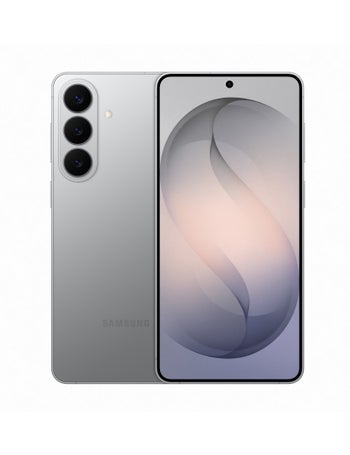
|
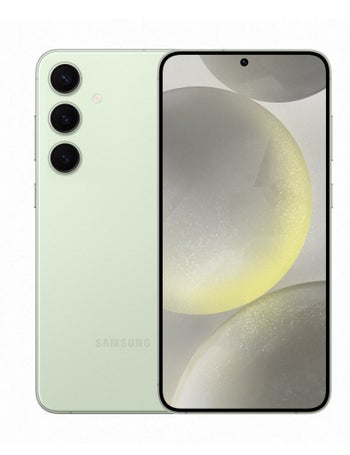
|
| Samsung Galaxy S26 | Samsung Galaxy S24 |
| Dimensions | |
|---|---|
| 149.6 x 71.7 x 7.2 mm (~10 mm with camera bump) | 147 x 70.6 x 7.6 mm (~8.85 mm with camera bump) |
| Weight | |
| 167.0 g | 168.0 g |
| Size | |
|---|---|
| 6.3-inch | 6.2-inch |
| Type | |
| Dynamic AMOLED, 120Hz | Dynamic AMOLED, 120Hz |
| System chip | |
|---|---|
| Snapdragon 8 Elite Gen 5 SM8850-AC (3 nm) | Snapdragon 8 Gen 3 SM8650-AB (4 nm) |
| Memory | |
| 12GB (LPDDR5X)/256GB (UFS 4.0) 12GB/512GB |
8GB (LPDDR5X)/128GB (UFS 3.1) 8GB/256GB |
| OS | |
| Android (16), up to 7 OS updates | Android (15, 14) |
| Type | |
|---|---|
| 4300 mAh | 4000 mAh |
| Charge speed | |
| Wired: 25.0W Wireless: 15.0W |
Wired: 25.0W Wireless: 15.0W |
| Main camera | |
|---|---|
| 50 MP (OIS, PDAF) Sensor name: Samsung GN3 Aperture size: F1.8 Focal length: 24 mm Sensor size: 1/1.56″ Pixel size: 1.0 μm |
50 MP (OIS, PDAF) Sensor name: Samsung GN3 Aperture size: F1.8 Focal length: 24 mm Sensor size: 1/1.56″ Pixel size: 1.0 μm |
| Second camera | |
| 12 MP (Ultra-wide) Sensor name: Sony IMX564 Aperture size: F2.2 Focal Length: 13 mm Sensor size: 1/2.55″ Pixel size: 1.4 μm |
12 MP (Ultra-wide) Sensor name: Sony IMX564 Aperture size: F2.0 Focal Length: 13 mm Sensor size: 1/2.55″ Pixel size: 1.4 μm |
| Third camera | |
| 10 MP (Telephoto, OIS, PDAF) Sensor name: Samsung S5K3K1 Optical zoom: 3.0x Aperture size: F2.4 Focal Length: 67 mm Sensor size: 1/3.94″ Pixel size: 1 μm |
10 MP (Telephoto) Sensor name: Samsung S5K3K1 Aperture size: F2.4 Focal Length: 67 mm Sensor size: 1/3.94″ Pixel size: 1.0 μm |
| Front | |
| 12 MP (HDR) | 12 MP (PDAF, HDR) |
| Bluetooth | |
|---|---|
| 5.4 | 5.3 |
| WLAN | |
| a,b,g,n,ac,Wi-Fi 6,Wi-Fi 6E,Wi-Fi 7 Wi-Fi Direct, Hotspot 802.11 a, b, g, n, ac, ax |
a,b,g,n,ac,Wi-Fi 6,Wi-Fi 6E Wi-Fi Direct, Hotspot 802.11 a, b, g, n, ac, ax |
| USB | |
| Type-C, USB 3.2 | Type-C, USB 3.2 |
| Sensors | |
| Accelerometer, Gyroscope, Compass, Barometer, Ambient light sensor, Proximity sensor | Accelerometer, Gyroscope, Compass, Barometer, Ambient light sensor, Proximity sensor |
| Hearing aid compatible | |
| M3/T4 | M3/T4 |
| Location | |
| GPS, A-GPS, Glonass, Galileo, BeiDou, Cell ID, Wi-Fi positioning | GPS, A-GPS, Glonass, Galileo, BeiDou, Cell ID, Wi-Fi positioning |
| Other | |
| NFC, Ultra Wideband (UWB) | NFC |
Samsung Galaxy S26 vs Samsung Galaxy S24 specs comparison
or compare them to other phones using our
Phone Comparison tool
Summary
Of course, we need to test the Galaxy S26 in our lab and give you all the nerdy data before passing on a final verdict, so stay tuned.