
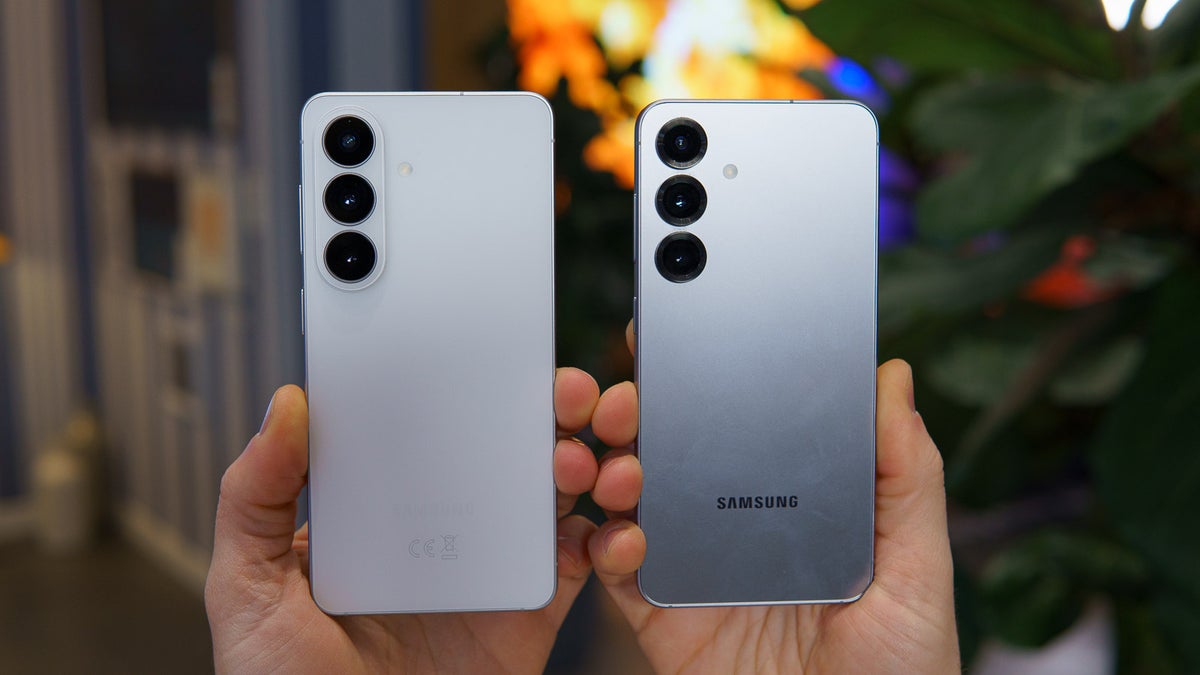
Samsung has officially unveiled the Galaxy S26 series! The wait is over and we have three models to choose from — the vanilla Galaxy S26, and the Plus and Ultra models. There’s no Galaxy Edge this year and all the rumors about a Pro model turned out false.
The new base Galaxy S26 model comes with slight upgrades here and there, nothing major. The screen is slightly bigger, the chipset has been upgraded, and the battery is larger. This inevitably raises the question — should you upgrade if you own the last-generation model?
What are the changes? Read on to find out!
| Galaxy S26 | Galaxy S25 |
|---|---|
| Similar design, slightly different camera housing | Small and compact, separate cutouts for the rear cameras |
| Faster Qualcomm Snapdragon 8 Elite Gen 5 chipset | Last generation Snapdragon 8 Elite chip, still plenty of power |
| Bigger 6.3-inch display | 6.2-inch screen, more compact phone |
| 12GB of RAM | 12GB of RAM on all memory configurations |
| Base onboard storage starts at 256GB | 128GB base storage |
| Bigger 4,300 mAh battery | Slightly smaller 4,000 mAh battery |
| 25W wired charging and 15W wireless charging speeds | The same charging speeds on this model as well |
Table of Contents:
Also read:
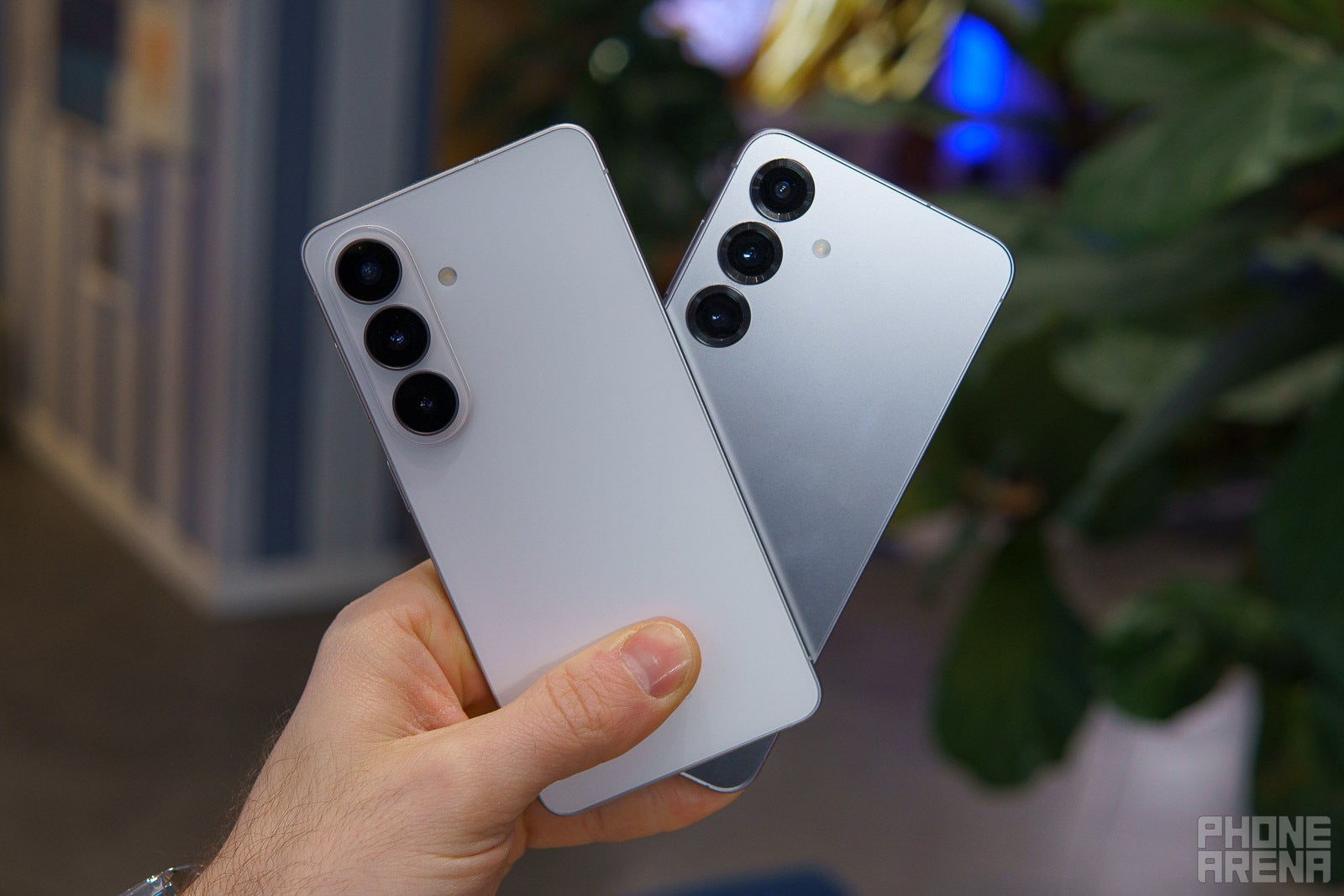
Design and Size
Back to oval one
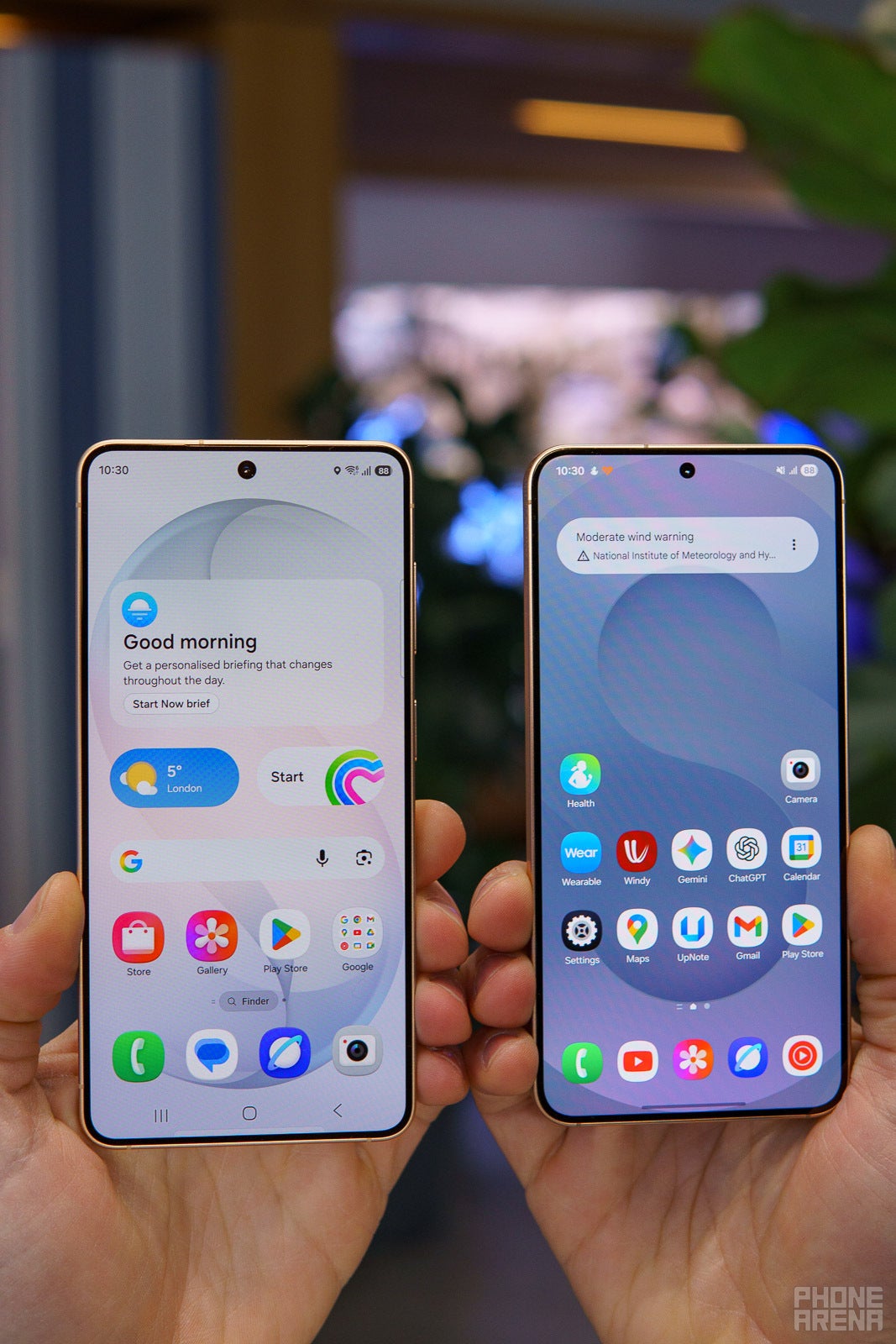
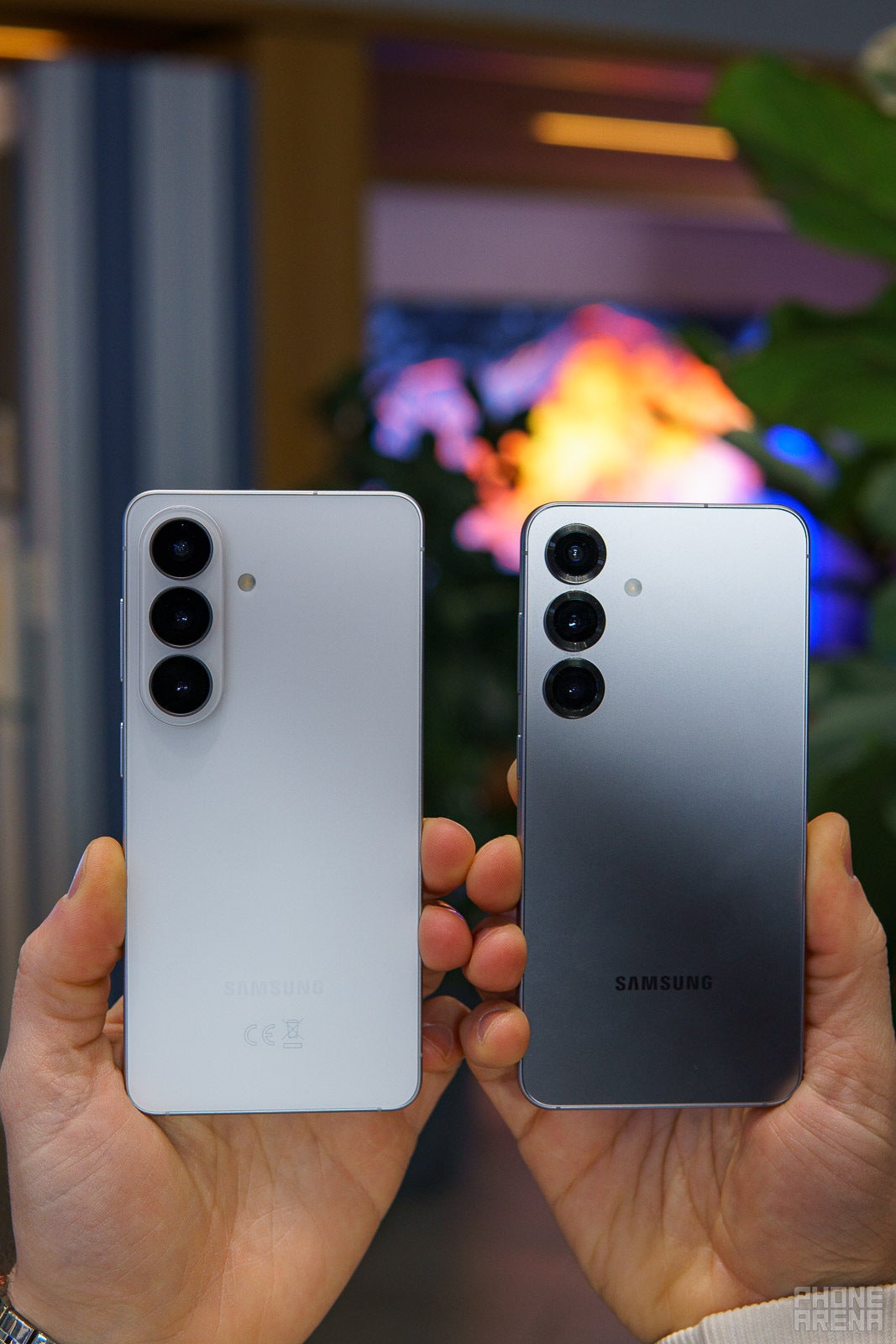
Interestingly, the thickness is the same at 7.2 mm, even though the Galaxy S26 has a bigger battery. The weight is also kept almost the same, the new phone is just 5 grams heavier than the Galaxy S25.
| Galaxy S26 | Galaxy S25 |
|---|---|
| Thickness 7.2 mm |
Thickness 7.2 mm |
| Dimensions 149.6 x 71.7 |
Dimensions 146.9 x 70.5 |
| Weight 167 grams |
Weight 162 grams |
In terms of materials, the Galaxy S26 relies on the same glass-metal sandwich as the previous generations, including the S25. The Gorilla Armor 2 protecting the S26 front and back is an upgrade from the Victus 2 on the S25, and we have the same aluminum frame as the one used on the previous generation.
In terms of colors, the Galaxy S26 is available in Cobalt Violet, Sky Blue, Black and White, with two additional exclusive colors – Pink Gold and Silver Shadow. The Galaxy S25, on the other hand is available in Icy Blue, Mint, Navy, Silver Shadow, Pink Gold, Coral Red, and Blue Black.
Display Differences
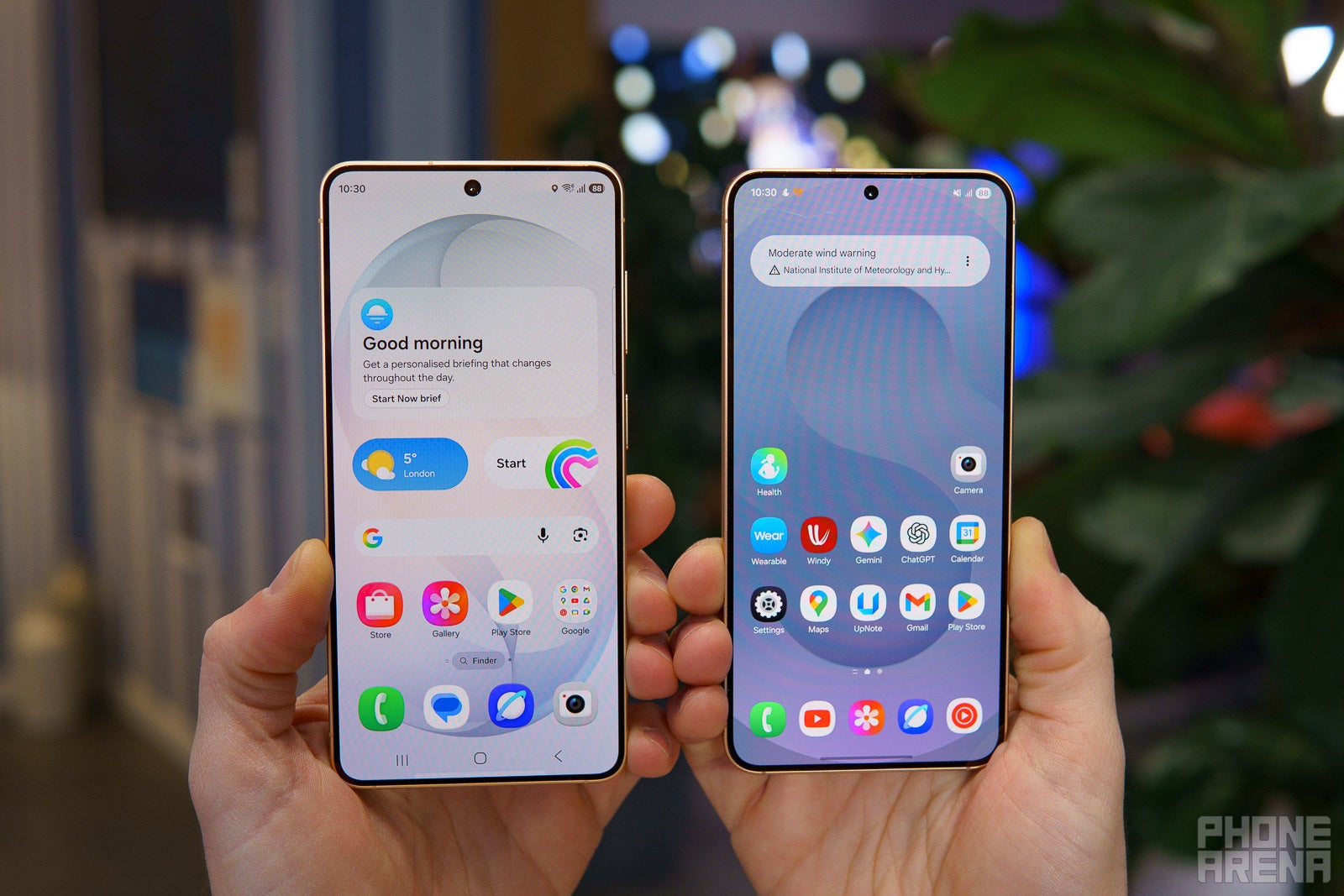
The Galaxy S25, on the other hand, features a slightly smaller 6.2-inch Super AMOLED screen with the same 1080 x 2340 pixel resolution, resulting in around 416 PPI pixel density. Samsung cites the same 2600 nits of peak brightness for that model as well, and in our display test we measured 2394 nits at 20% APL, which is an impressive result.
| Galaxy S26 | Galaxy S25 |
|---|---|
| Size 6.3″ |
Size 6.2″ |
| Brightness 2600 nits (peak) |
Brightness 2600 nits (peak) |
We will conduct our display tests as soon as the S26 arrives in our lab, but looking at the specs, both displays look very similar, with just a 0.1-inch difference in size. The under-display fingerprint sensor can be found on both devices – it’s an ultrasonic one, working fast and reliably.
Performance and Software
Snapdragon for some, Exynos for others
The Samsung Galaxy S26 serves as a testbed for the Exynos 2600 chipset in Europe and some other regions of the world, but in North America, China and Japan, the phone comes equipped with a Snapdragon 8 Elite Gen 5 chipset, just like the Ultra model.
The Snapdragon is a real powerhouse and early benchmarks show Geekbench 6 single- and multicore scores around 3800 and 12400 respectively. The Exynos variant should be on par in terms of multicore performance, and some Geekbench 6 posts show a slightly lower single-core scores.
Nevertheless, the Exynos variant of the S26 could be more energy efficient, as it’s made using 2nm manufacturing technology, while the Snapdragon 8 Elite Gen 5 is a 3nm chip. It’s also worth mentioning that Qualcomm optimizes and overclocks its Snapdragon chips for the Galaxy lineup, hence the moniker “for Galaxy.”
In comparison, the Galaxy S25 features the previous version of that silicon, the first “Elite” chip from Qualcomm. The phone managed 3031 and 9621 in the same Geekbench 6 single- and multicore tests. We’ll run the tests on the S26 once it lands in our lab.
| Galaxy S26 | Galaxy S25 |
|---|---|
| Chip Qualcomm Snapdragon 8 Elite Gen 5 Exynos 2600 |
Chip Qualcomm Snapdragon 8 Elite |
| Process 3nm 2nm |
Process 3nm |
| RAM, Storage 12/256GB 12/512GB LPDDR5X RAM |
RAM, Storage 12/128GB 12/256GB 12/512GB LPDDR5X RAM |
In terms of RAM, the new model features the same 12GB as the S25. There were some initial rumors suggesting we might be getting 16GB of RAM on the vanilla model, but they didn’t turn out to be true. There’s a change in base storage from 128GB to 256GB – Samsung ditched the 128GB model, but also bumped up the price of the new base variant starting at 256GB now.
Camera
No upgrades sadly
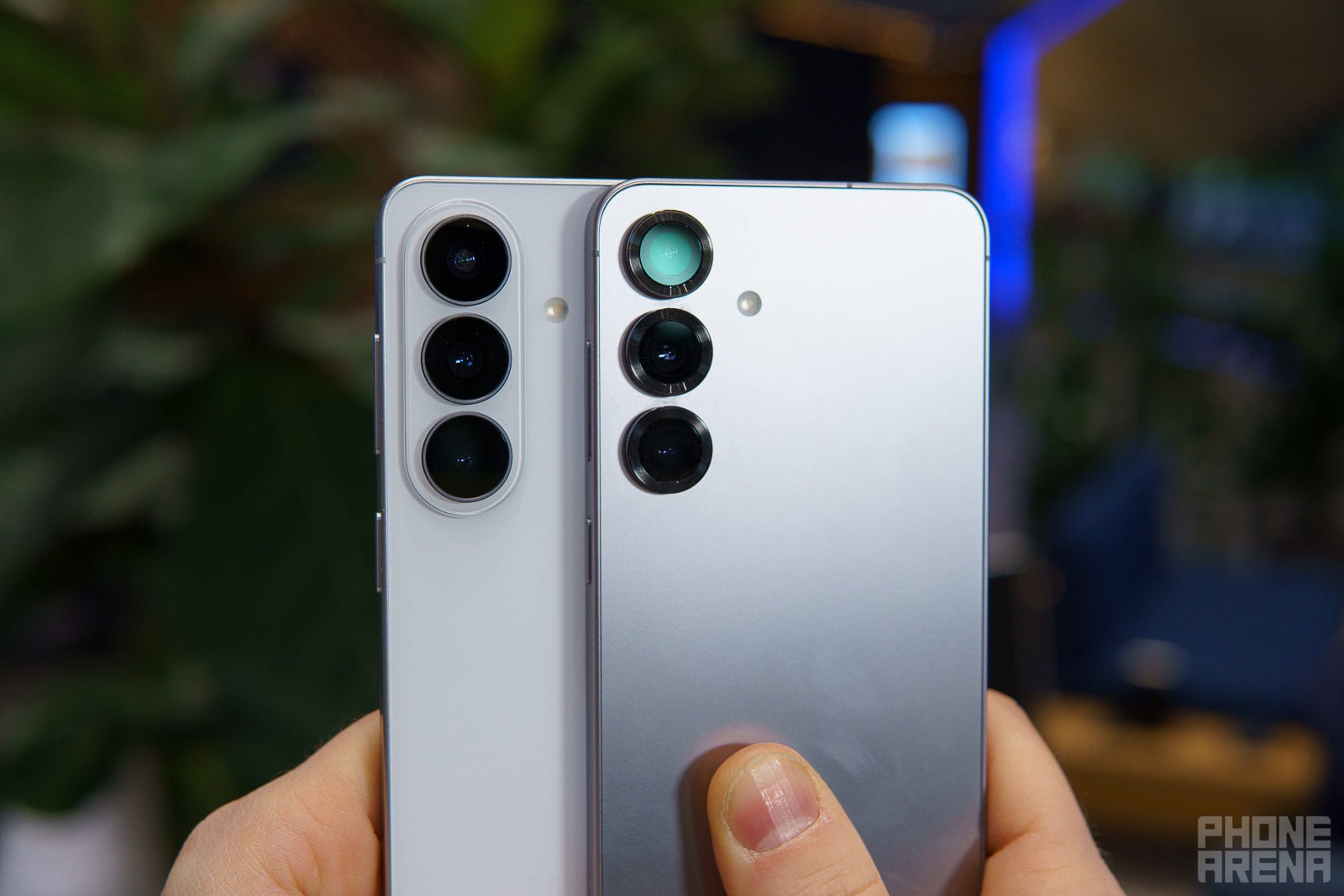
Samsung has been reluctant in bringing camera upgrades to the base model in the past couple of generations, and this remains unchanged in this generation as well, sadly.
The Galaxy S26 features the exact same camera hardware as its predecessor, and while there might be some software optimization and new algorithms on board, the sensors and lenses are the same as the one used in the Galaxy S25.
Speaking of, the S25 features a triple camera system on its back, including one 50MP wide camera, a 10MP telephoto with 3x optical zoom, and a 12MP ultrawide. The front camera is a 12MP snapper, and it’s the same on the S26 as well.
| Galaxy S26 | Galaxy S25 |
|---|---|
| Main 50 MP, f/1.8 24 mm 1/1.56″ |
Main 50 MP, f/1.8 24 mm 1/1.56″ |
| Ultrawide 12 MP, f/2.2 13 mm 1/2.55″ |
Ultrawide 12 MP, f/2.2 13 mm 1/2.55″ |
| Telephoto 10 MP, f/2.4 3X zoom (67mm) 1/3.94″ |
Telephoto 10 MP, f/2.4 3X zoom (67mm) 1/3.94″ |
The Galaxy S25 scored 147 (out of 158) in our composite camera benchmark, and we expect this score to go a bit higher on the S26, mainly due to software optimizations and new AI tricks. We’ll snap some side-by-side samples once the S26 lands in our lab.
Battery Life and Charging
300 mAh more
The Galaxy S25 managed a battery life estimate of 7h 6m, which put it at 66th place among phones tested in the past 2 years. We expect a slightly better result from the Galaxy S26, but don’t hold your breath. 300 mAh can only do so much. Again, stay tuned for tests and some hard numbers here soon.
| Galaxy S26 | Galaxy S25 |
|---|---|
| Battery size 4,300 mAh |
Battery size 4,000 mAh |
|
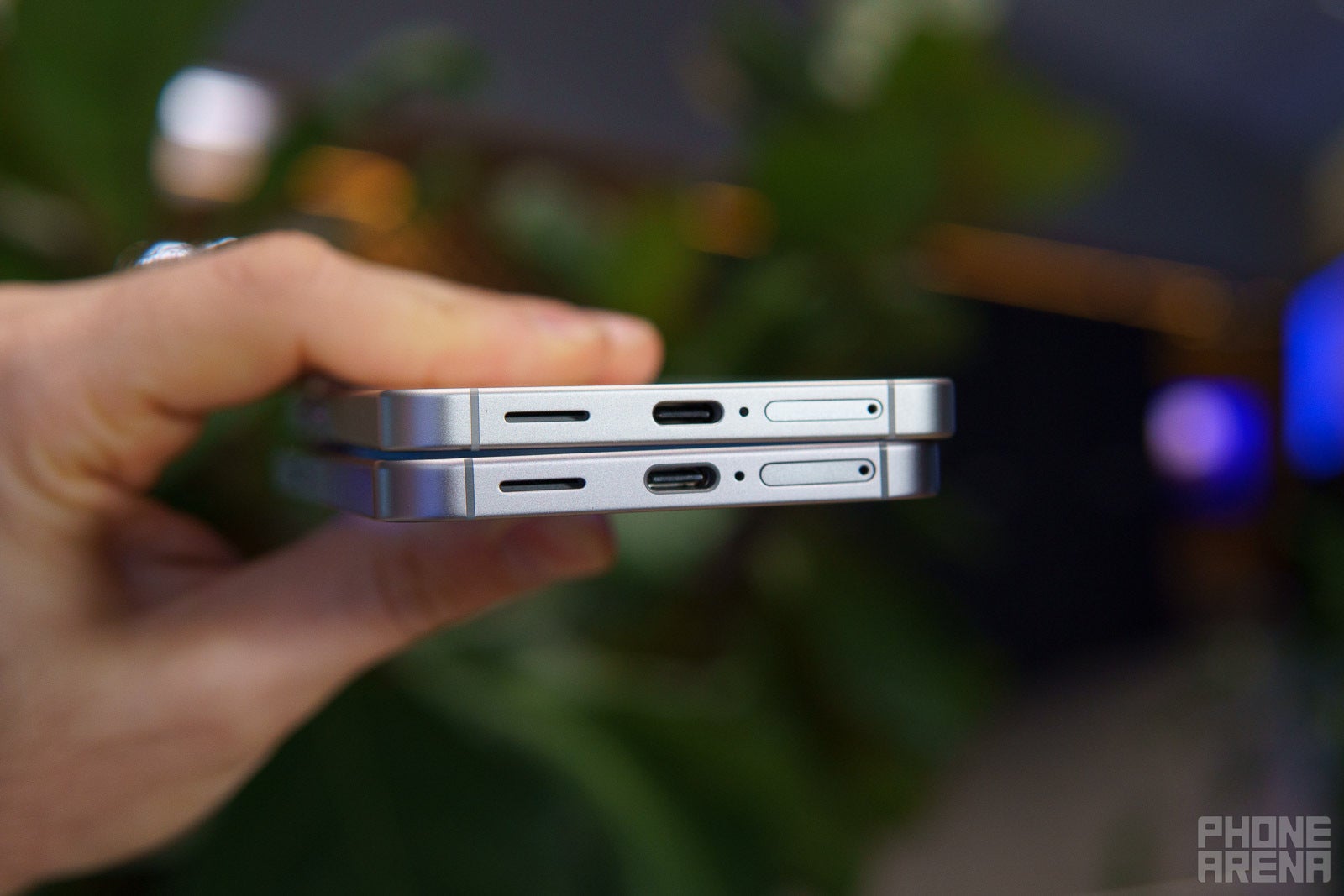
Charging speeds 15W wireless charging USB-C 2.0 |
Charging speeds 25W wired 15W wireless charging USB-C 2.0 |
Charging speeds has been carried over from the previous generation as well, which is a bit disappointing. The Galaxy S25 supports 25W of wired charging power and fills its battery from zero to full in 1 hour and 22 minutes.
The Galaxy S26 features the same charging speeds – 25W wired and 15W wireless. Samsung cites 55% in 30 minutes with a 25W charge and we’re going to test those claims in our lab soon. But all in all, no big difference between the S26 and S25.
Specs Comparison
Here’s a quick specs overview of the two phones. For a detailed Galaxy S26 vs Galaxy S25 specs comparison follow the link.
|
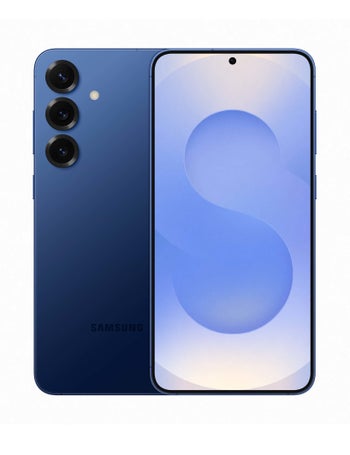
|
| Samsung Galaxy S26 | Samsung Galaxy S25 |
| Dimensions | |
|---|---|
| 149.6 x 71.7 x 7.2 mm (~10 mm with camera bump) | 146.9 x 70.5 x 7.2 mm (~8.45 mm with camera bump) |
| Weight | |
| 167.0 g | 162.0 g |
| Size | |
|---|---|
| 6.3-inch | 6.2-inch |
| Type | |
| Dynamic AMOLED, 120Hz | Dynamic AMOLED, 120Hz |
| System chip | |
|---|---|
| Snapdragon 8 Elite Gen 5 SM8850-AC (3 nm) | Snapdragon 8 Elite SM8750-AB (3 nm) |
| Memory | |
| 12GB (LPDDR5X)/256GB (UFS 4.0) 12GB/512GB |
12GB (LPDDR5X)/128GB (UFS 4.0) 12GB/256GB 12GB/512GB |
| OS | |
| Android (16), up to 7 OS updates | Android (15), up to 7 OS updates |
| Type | |
|---|---|
| 4300 mAh | 4000 mAh |
| Charge speed | |
| Wired: 25.0W Wireless: 15.0W |
Wired: 25.0W Wireless: 15.0W |
| Main camera | |
|---|---|
| 50 MP (OIS, PDAF) Sensor name: Samsung GN3 Aperture size: F1.8 Focal length: 24 mm Sensor size: 1/1.56″ Pixel size: 1.0 μm |
50 MP (OIS, PDAF) Sensor name: Samsung GN3 Aperture size: F1.8 Focal length: 24 mm Sensor size: 1/1.56″ Pixel size: 1.0 μm |
| Second camera | |
| 12 MP (Ultra-wide) Sensor name: Sony IMX564 Aperture size: F2.2 Focal Length: 13 mm Sensor size: 1/2.55″ Pixel size: 1.4 μm |
12 MP (Ultra-wide) Sensor name: Sony IMX564 Aperture size: F2.2 Focal Length: 13 mm Sensor size: 1/2.55″ Pixel size: 1.4 μm |
| Third camera | |
| 10 MP (Telephoto, OIS, PDAF) Sensor name: Samsung S5K3K1 Optical zoom: 3.0x Aperture size: F2.4 Focal Length: 67 mm Sensor size: 1/3.94″ Pixel size: 1 μm |
10 MP (Telephoto) Sensor name: Samsung S5K3K1 Optical zoom: 3.0x Aperture size: F2.4 Focal Length: 67 mm Sensor size: 1/3.94″ Pixel size: 1.0 μm |
| Front | |
| 12 MP (HDR) | 12 MP (HDR) |
| Bluetooth | |
|---|---|
| 5.4 | 5.4 |
| WLAN | |
| a,b,g,n,ac,Wi-Fi 6,Wi-Fi 6E,Wi-Fi 7 Wi-Fi Direct, Hotspot 802.11 a, b, g, n, ac, ax |
a,b,g,n,ac,Wi-Fi 6,Wi-Fi 6E,Wi-Fi 7 Wi-Fi Direct, Hotspot 802.11 a, b, g, n, ac, ax |
| USB | |
| Type-C, USB 3.2 | Type-C, USB 3.2 |
| Sensors | |
| Accelerometer, Gyroscope, Compass, Barometer, Ambient light sensor, Proximity sensor | Accelerometer, Gyroscope, Compass, Barometer, Ambient light sensor, Proximity sensor |
| Hearing aid compatible | |
| M3/T4 | M3/T4 |
| Location | |
| GPS, A-GPS, Glonass, Galileo, BeiDou, Cell ID, Wi-Fi positioning | GPS, A-GPS, Glonass, Galileo, BeiDou, Cell ID, Wi-Fi positioning |
| Other | |
| NFC, Ultra Wideband (UWB) | NFC, Ultra Wideband (UWB) |
Samsung Galaxy S26 vs Samsung Galaxy S25 specs comparison
or compare them to other phones using our
Phone Comparison tool
Summary
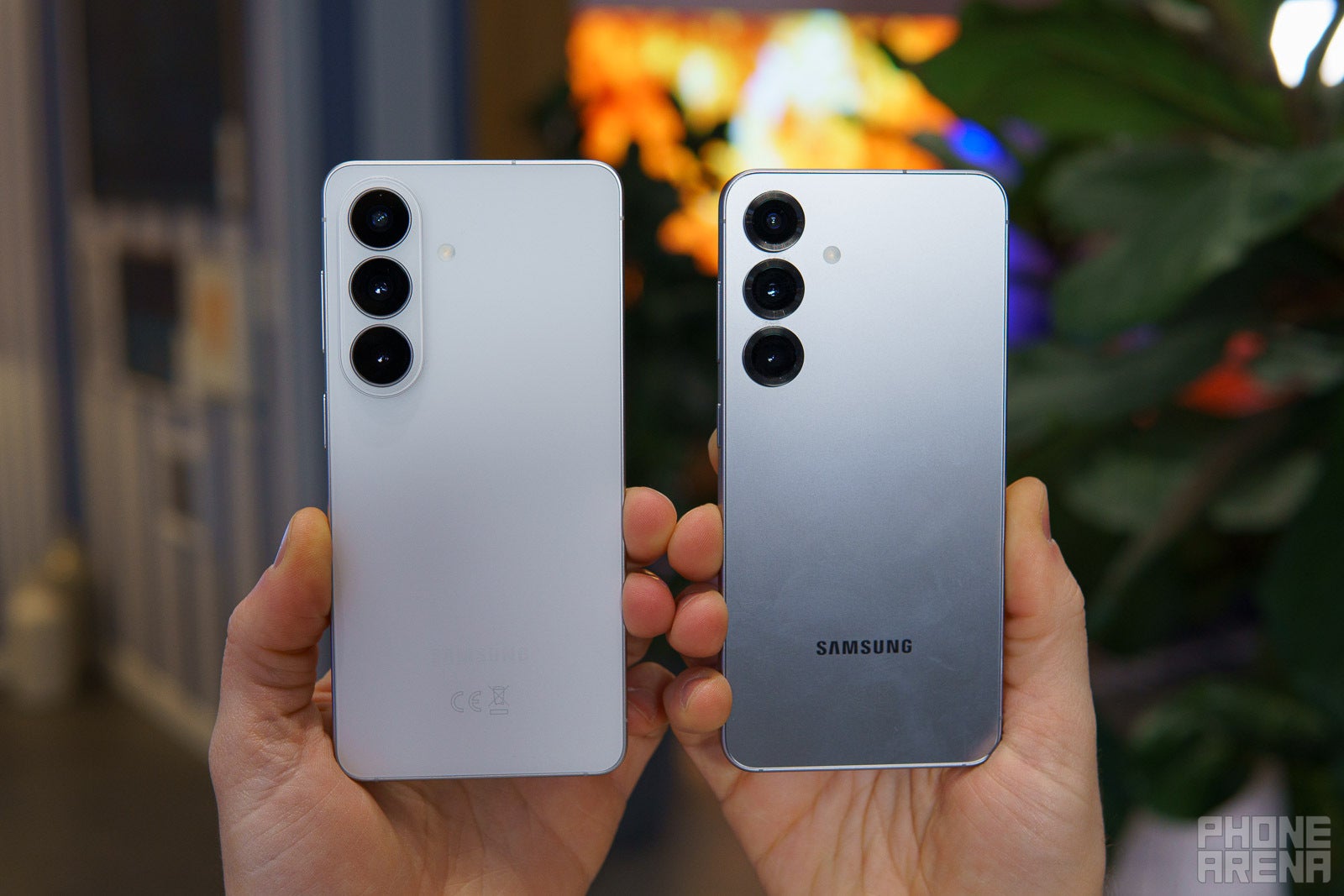
We’re not sure if the Snapdragon 8 Elite Gen 5 will be enough to justify an upgrade, especially from the Galaxy S25, but we’ll have to wait and test the device ourselves before jumping to conclusions.
Next to the Galaxy S25, this phone looks like a minor step up, and you probably shouldn’t upgrade if you already own the S25. On the other hand, if you’re coming from an older Galaxy or switching from an iPhone, the S26 is a decent choice.
It’s also worth noting that this year the S26 moves to 256GB base storage and a starting price of $899.99, so it’s $100 more expensive than the S25 with 128GB base memory. We will update this comparison with tests, benchmarks, and samples once the Galaxy S26 arrives in our lab, so stay tuned for a final verdict soon.