


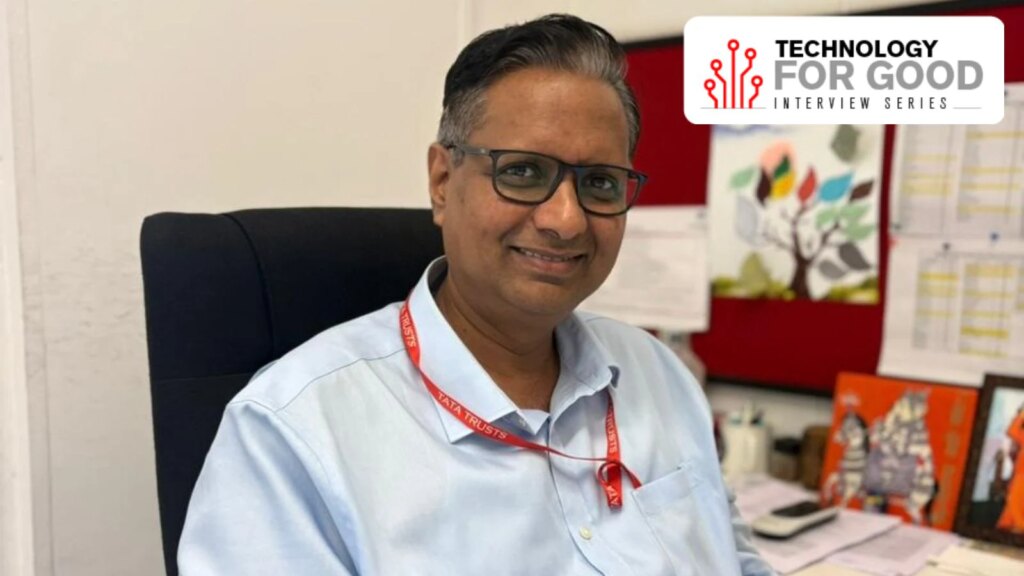
HSD Srinivas leads and manages primary healthcare initiatives at Tata Trusts, one of India’s oldest and largest philanthropic institutions.
Tata Trusts has played a pivotal role in strengthening India’s healthcare ecosystem by collaborating with governments, non-profits, researchers, innovators and startups to support affordable and scalable tech-led interventions in the health sector.
With over 34 years of experience, Srinivas has shaped innovations in healthcare delivery systems across India.
Prior to joining Tata Trusts, Srinivas led community health initiatives at Reliance Foundation. He also held leadership roles at the L.V. Prasad Eye Institute, Hyderabad, and served as the COO for Andhra Pradesh operations at GVK EMRI (Emergency Management and Research Institute).
Srinivas holds an engineering degree and an MBA, and has completed executive education in Healthcare Delivery and Strategy from Harvard Business School.
Srinivas spoke to indianexpress.com on the work of Tata Trusts, the medtech interventions that work and those that fail, and the technologies to look out for in the Indian public health sector. Edited excerpts:
Venkatesh Kannaiah: Tell us about Tata Trusts’ work in India’s health sector.
H.S.D Srinivas: Healthcare is a major focus area across all of our 16 trusts. While each trust has its own charter and focus, health features in most as an intervention area. Across all the trusts, we spent around Rs 1,200 crore last year on healthcare.
Story continues below this ad
Within healthcare, we look at four areas. The first is cancer care, where we build infrastructure, equip hospitals, and run them. Tata Cancer Care Foundation runs three hospitals and is in the process of building another.
The second area, which I manage, covers everything other than cancer. This mostly involves public health, with a strong focus on primary care interventions.
The third area is nutrition. The fourth, and most recent, is the Tata Health Care Foundation, which is working towards building hospitals across various cities in India.
Venkatesh Kannaiah: Tell us about your work in public health.
H.S.D Srinivas: In public health, we have an emphasis on primary care interventions. We have spent around Rs 100 crore a year over the last 10 years. We work on creating better access to multiple services at the primary care level.
Story continues below this ad
There is a focus on disadvantaged groups; the non-working population, such as mothers, children, and the elderly, who are typically underserved. In India, health investments tend to prioritise the working male as the primary earner for the family.
The government, especially since the launch of the National Rural Health Mission, has made significant progress in addressing the needs of expectant mothers and children.
Most of the time, our team looks at existing problems and proven solutions and how to scale these solutions. We also explore newer innovations that can address these known challenges.
We work across three major verticals. One is maternal and child health, along with adolescent health. The second is non-communicable diseases (NCDs). And the third is communicable diseases.
Story continues below this ad
Venkatesh Kannaiah: Tell us about your early digital health interventions in India.
H.S.D Srinivas: We believe technology has a major role in bringing both equity and efficiency into existing systems.
From 2015-16 onwards, 4G services began to penetrate rural areas, and it was a time for experimentation. Telemedicine has been around for nearly 30 years, but it was often seen as a failure largely due to weak community connect and patchy connectivity, since it depended heavily on satellite systems.
Once broadband improved and India moved towards cheap data, we were able to leverage it, and over the next 4-5 years, we experimented with multiple models.
One was the hub-and-spoke approach, where a hospital acted as a central hub with multiple spokes. The hospital managed telemedicine units as part of its outreach programme. We implemented this with the Ramakrishna Mission hospitals in Mathura and Vrindavan, which served as hubs, with around 15 spokes around them. People no longer had to travel 30-100 km for basic illnesses like fever or diarrhoea.
Story continues below this ad
Another was a centralised care coordination centre in Hyderabad, which connected with primary health centres (PHCs) and sub-centres across four districts in Telangana. This was done in partnership with the state health department. Doctors at the hub could guide nurses at the last-mile facilities.
This early work also coincided with the evolution of larger government platforms like eSanjeevani.
A third model we tried was in Vijayawada, where Tata Trusts had their own set of doctors supporting about 20 rural centres.
Telemedicine eventually proved to be a big success, especially during Covid, when both the medical community and the government formally accepted it as a legitimate mode of care delivery. Before that, there were no clear guidelines or standards.
Story continues below this ad
Venkatesh Kannaiah: How do you work with governments to scale medtech solutions across India?
H.S.D Srinivas: In terms of scale and impact, our work is largely catalytic. We develop models, demonstrate their effectiveness, and then support governments in scaling them. We work with the Union government and multiple state governments across India.
Alongside our early forays in digital health interventions, we also worked on technology for non-communicable diseases. Around 2016-17, there was growing awareness that India was facing a rising NCD burden. The government recognised the need for population-level screening, which wouldn’t be feasible without a technology backbone.
We worked with Dell EMC, which had developed an application, and after the initial pilot, scaled it across multiple districts in Andhra Pradesh.
The Telangana government expanded this to all 33 districts, and later the Government of India adopted it and scaled it nationally. Tata Trusts partnered in deploying and refining the platform across nearly 650-700 districts.
Story continues below this ad
Today, the platform, now handed over fully to the government, contains around 55 crore records of adults above 35 years, with about 35 crore individuals screened.
In Telangana, we also demonstrated how around 700 PHCs could be connected to nearly 60 medical colleges and district centres. This reduced patient travel and saved livelihoods in outpatient settings.
Apart from telemedicine, point-of-care devices play an important role. They reduce the need for diagnostic labs everywhere. In Nagpur, we upgraded around 25 urban PHCs and built systems to integrate drug supply chains and diagnostics. We also set up a centralised lab that processed samples from across the city and sent reports back.
I would say technology today plays about 30-40 per cent of the role in care delivery. Traditionally, we’ve believed that good doctors, nurses, and medicines are sufficient, which is true. But if you want to deliver care at scale, technology becomes essential. It needs to be intelligently designed to drive efficiency.
Story continues below this ad
We partnered with the government of Madhya Pradesh to develop supportive supervision for nurses across about 23 high-priority districts. In the first five years, we identified close to 7,500 quality-related issues and worked with the government to address them.
We worked on upgrading about 500 Health and Wellness Centres, a step below PHCs, which are expected to deliver a wider range of services closer to communities. We developed methodologies and introduced supply chain software like eAushadhi.
So, our role has largely been to identify relevant technologies and help frontline workers adopt them.
Venkatesh Kannaiah: How do you structure your interventions?
H.S.D Srinivas: We start with research, understanding the landscape and identifying gaps. For example, we recognised that non-communicable diseases were rising across the country, while primary care systems were still geared towards maternal and child health.
We then develop and demonstrate solutions, generate evidence, and share learnings. Where required, we support adoption through partnerships with the government.
Venkatesh Kannaiah: What do you think are the big challenges in deploying MedTech in rural India?
H.S.D Srinivas: I would say there are issues within the government, especially when it comes to reaching the last mile.
About 70 per cent of India is reasonably well served. The remaining 30 per cent still need consistent power and connectivity. If that improves, we can do a lot more and deliver much more effectively.
The second is around technology adoption. I still feel there’s room for it to be adopted more aggressively by policymakers.
There has always been some doubt about the veracity of data. And that’s partly because when targets are set, people are under pressure to report numbers. So, the correctness and completeness of the data can sometimes be questionable.
Venkatesh Kannaiah: So, how do you work to resolve these issues?
H.S.D Srinivas: When we create some of these apps, that itself becomes an issue for the government, because there are multiple apps, often from well-intentioned NGOs, each wanting their solution to be adopted.
But now, with more reliable data systems and AI coming in, there is greater certainty on how data can be captured. Today, conversations between a patient and a doctor can actually be captured, transcribed, and even shared with the patient before they leave. So, both in terms of order entry and identifying patient symptoms, this can reduce errors.
One of the reasons for reluctance in adopting technology earlier was that doctors felt it interfered with care. Now, that barrier is reducing. The doctor can simply have a normal conversation and it gets transcribed in real time and made available immediately.
These are some of the technologies that can really help. And then, of course, there’s the increased use of electronic patient records and automation.
Venkatesh Kannaiah: What are the futuristic technologies that you want to bet on for a big impact?
H.S.D Srinivas: There are many promising technologies which can help; it’s not just IT-related, but also product-related innovations.
Some wearables can monitor most vitals on a daily basis, continuously and without effort. If these are connected to a hospital or a central hub, a doctor can get alerted whenever something goes wrong. If we can make that accessible to the common person, that would be a big shift.
Second is genome mapping. Today, those who can afford it can get their genome mapped for around Rs 30,000-35,000. That gives you a sense of what diseases you may be prone to, so you can take preventive steps.
If we can reduce that cost, it becomes a blueprint that every citizen can have for more precise, personalised medicine.
AI-led diagnostics, mHealth — these are proven areas with strong potential if applied intelligently.
At the same time, there is also a challenge for policymakers: the proliferation of solutions. For the same problem, you may have four different solutions competing.
Beyond AI, we are also looking at technologies like augmented reality and virtual reality. These can help in capacity building for frontline health workers and also improve patient experience.
Another important area is how the right information is shared with patients and their families. Today, especially in hospitals, there is often very limited communication. This creates a trust gap — patients are unsure whether they are receiving the right advice or standard care. So, patient empowerment is critical.
With better patient education and wider access to reliable information, we can democratise healthcare to some extent.
Venkatesh Kannaiah: Tell us about a few technologies that have not worked in rural India.
H.S.D Srinivas: Virtual Reality in health tech solutions has been around for quite some time, but I wouldn’t call it a failure per se; it’s more about barriers to adoption.
Medical research suggests that only about 9-10 per cent of innovations get embedded into public health systems. Nearly 90 per cent fall by the wayside over a 30-40 year period. So, introducing any new way of doing things requires workarounds; reducing barriers, lowering costs, and so on.
Even with things like point-of-care devices, the initial promise is very strong. The challenge comes with scale. For example, calibration can become an issue. A device may work perfectly for individual use, but when you start using it at scale, say by the 100th patient, the calibration may drift. So the question is: how do we develop low-cost devices that can operate at scale while maintaining the same level of precision?
When you talk about VR, it depends on the context. In our case, we look at it largely for capacity building. For example, a surgeon preparing for a procedure could use it to visualise the location of a tumour before entering the operating theatre. It’s a powerful tool, and while it is already in use in universities globally, bringing it to India at scale will take time.
VR has a clear role in capacity building. But like any technology, it has specific use cases; it’s not universal. Its application needs to be seen both from the provider’s and the patient’s perspective.
Venkatesh Kannaiah: How do you work with startups in the field? Name some startups which impressed you.
H.S.D Srinivas: We have tried to encourage and fund a few promising technologies, especially through a dedicated fund called India Health Fund, which focuses on technologies addressing tuberculosis and malaria.
This includes point-of-care devices and newer approaches, not drug development per se, but more into areas like AI-based diagnostics for chest-related diseases.
We partner with multiple organisations to help bring innovations to market. Now, as part of our broader mandate, we don’t directly fund everything, but through the India Health Fund, we support product development in areas like TB and malaria.
During Covid, the question was how to work with solutions that we already have. We were working with Molbio Diagnostics on PCR-based diagnostics for tuberculosis and were able to re-purpose the existing technology.
There is Qure.ai, which is into diagnostics for early detection of tuberculosis and lung infections. They had multiple partners, and we came in towards the later stages and provided funding.
Another example is Swaasa, which we supported. It is an AI-based tool where a person simply coughs into a mobile phone, and the system predicts the type of chest disease.
Earlier, we also helped deploy solutions of PathShodh, an affordable medical testing device company, and demonstrated platforms like Trinetra, a suitcase-based diagnostic tool for eye care.
Funding for startups is routed through the India Health Fund, but when we work on the ground with NGOs and partners, we focus on demonstrating new technologies in real-world conditions so they can prove themselves.
For instance, in tribal areas of Maharashtra, we worked with a diagnostic innovation from the Centre for Cellular and Molecular Biology (CCMB), which could detect the likelihood of sickle cell anaemia through the dried blood spot method, with just a single prick of blood. While CCMB developed the tech, we helped bring it to the field, demonstrating it across nearly 30,000 tribal families. This enabled early detection at scale.
We work across both ICT-based technologies and product innovations, especially in surveillance and diagnostics, helping them move from lab to field.
Venkatesh Kannaiah: If there is one big issue that you want to solve in your field, what would it be?
H.S.D Srinivas: Quality and accessibility are the two biggest factors. On accessibility, we’ve made some progress in the last few years. But on quality in public health systems, there is still a lot more that can be done.